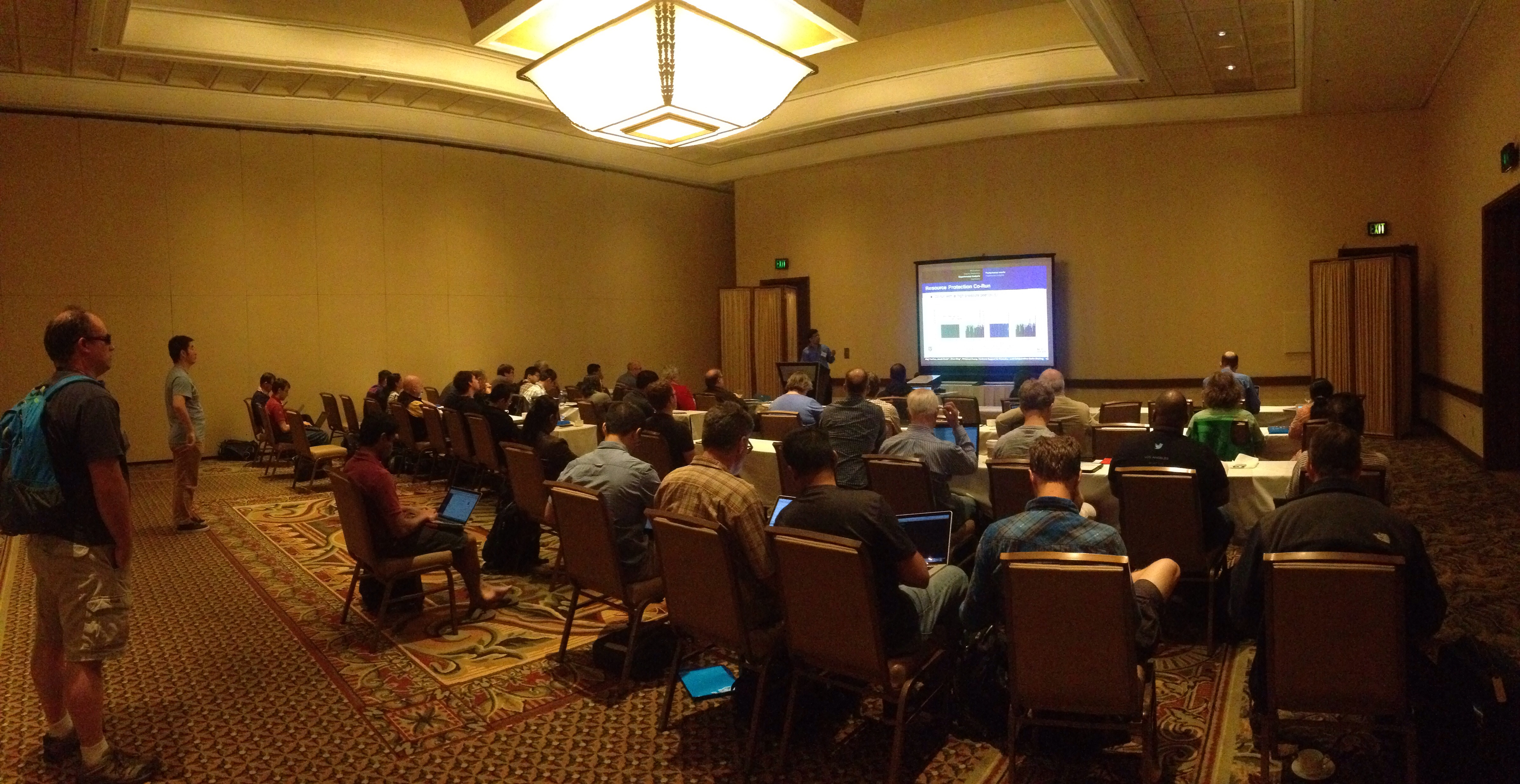
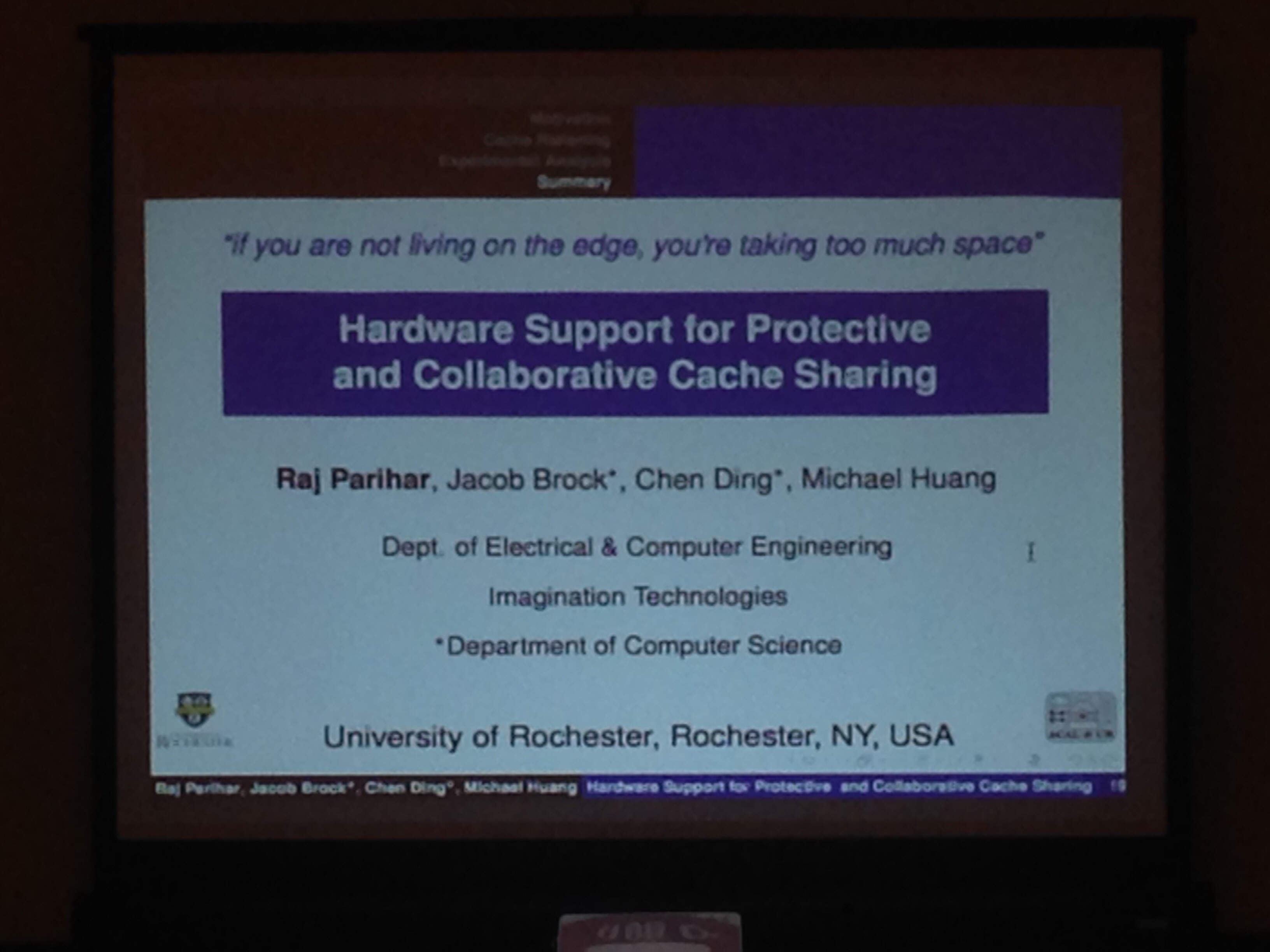
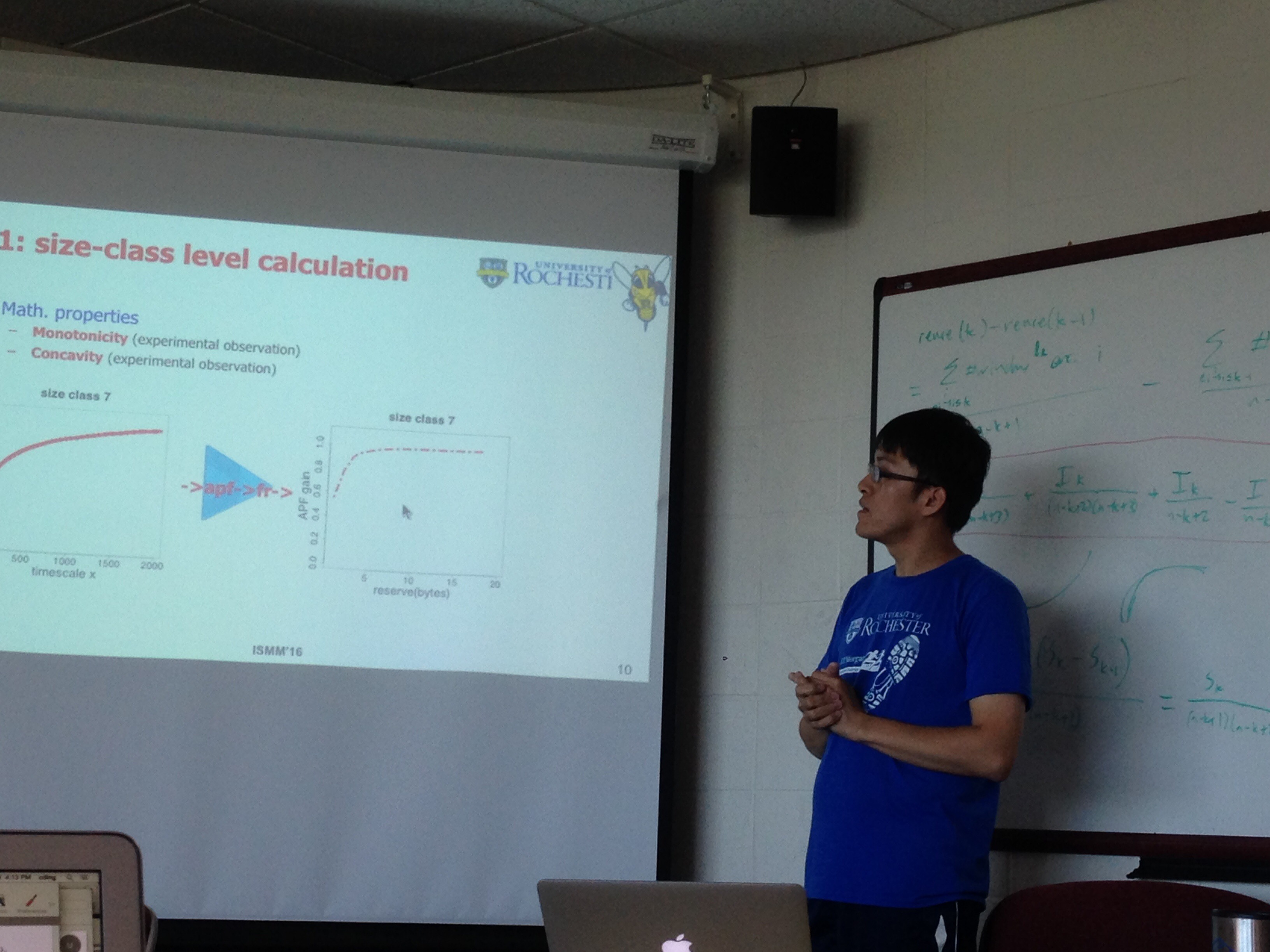
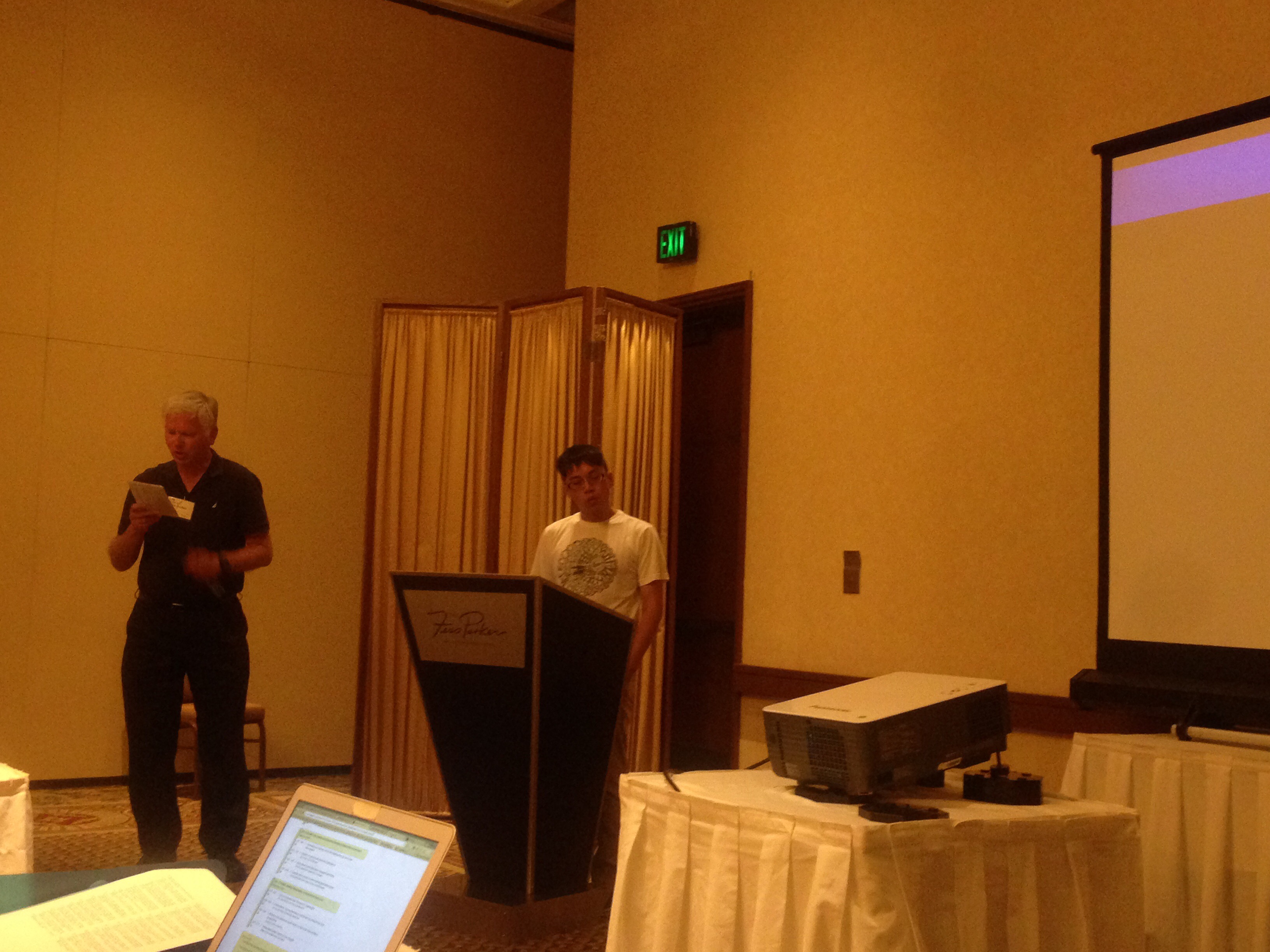
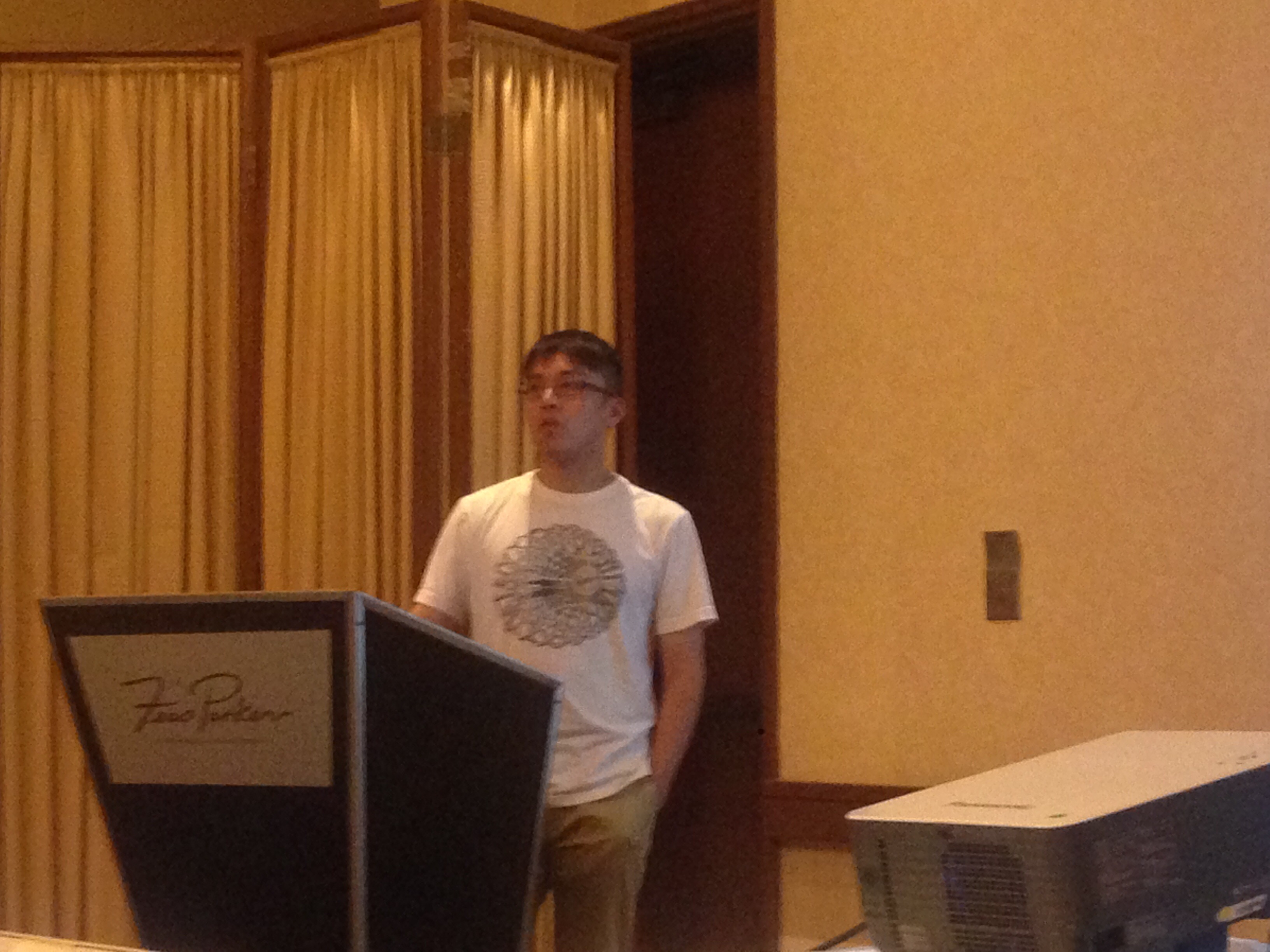
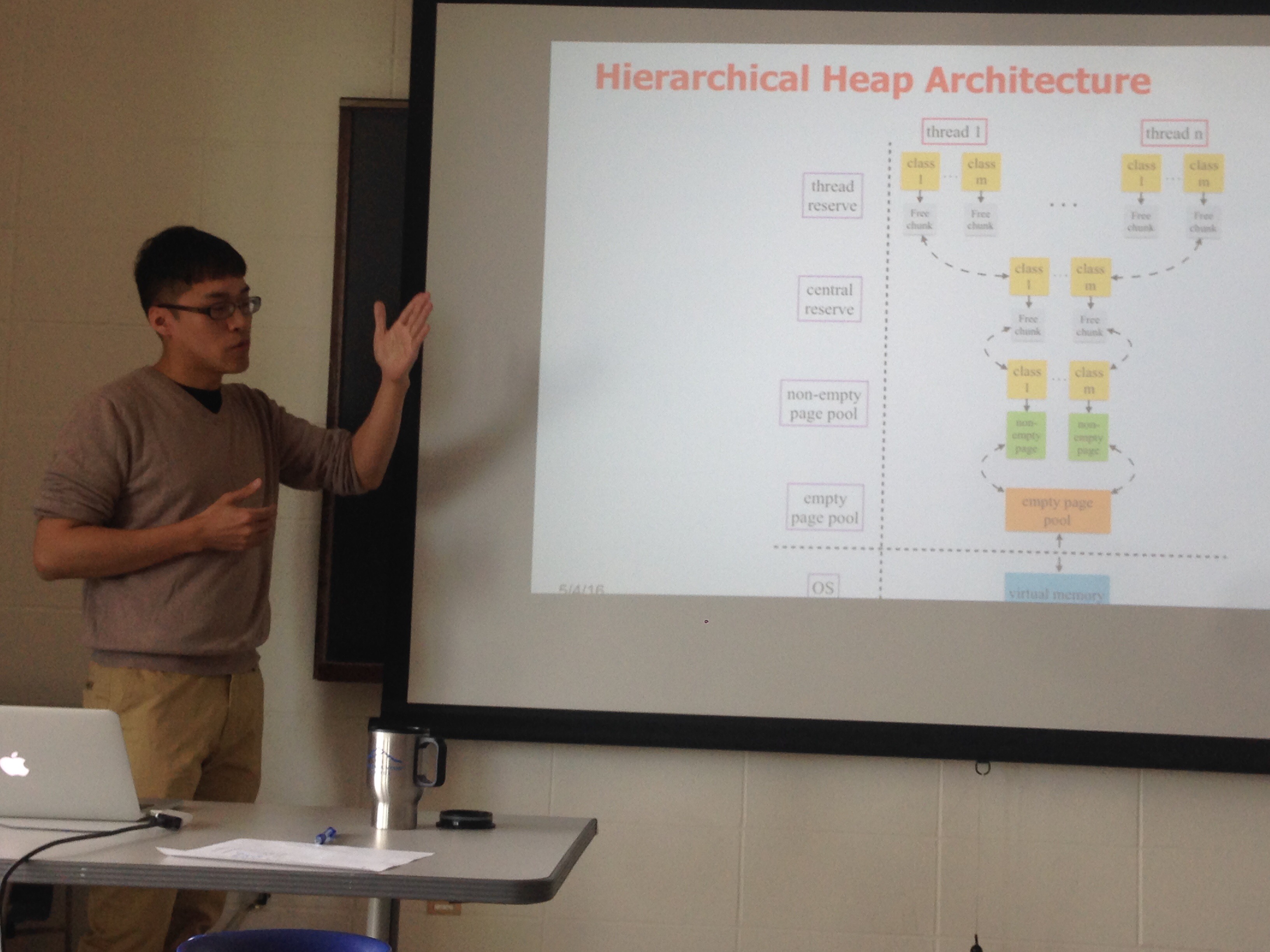
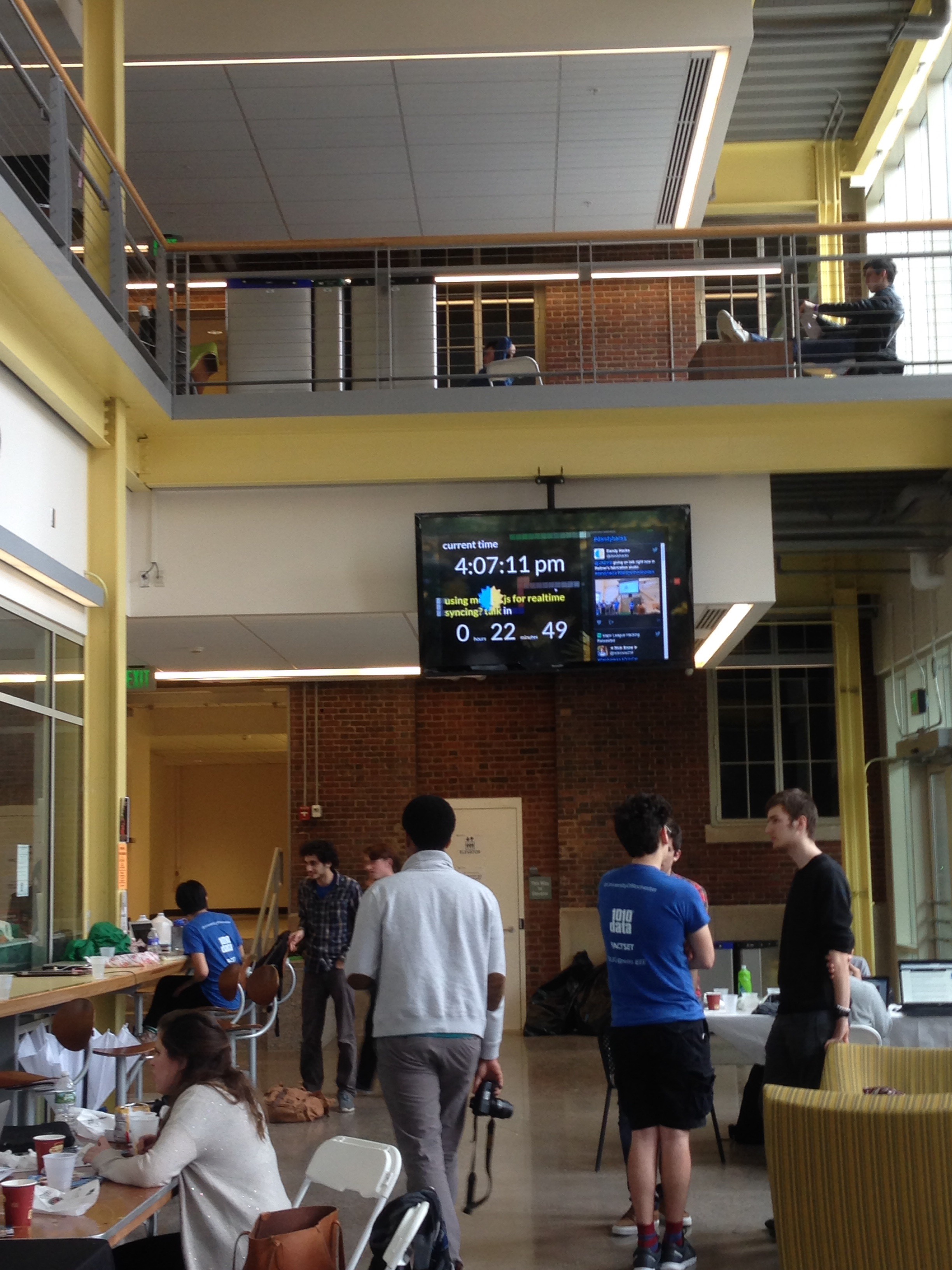
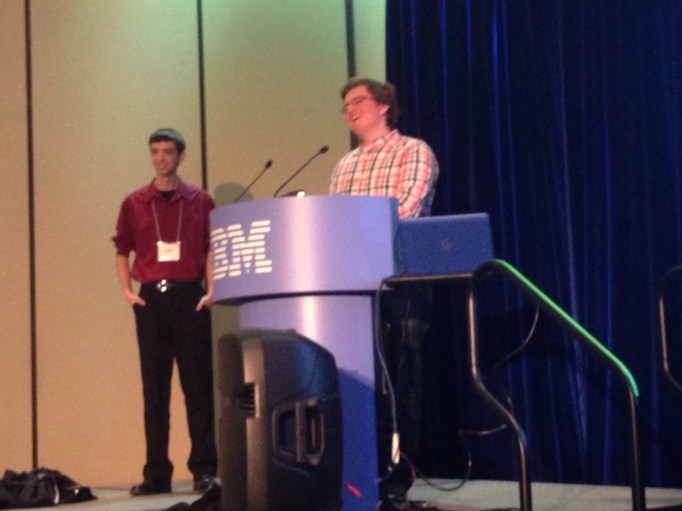
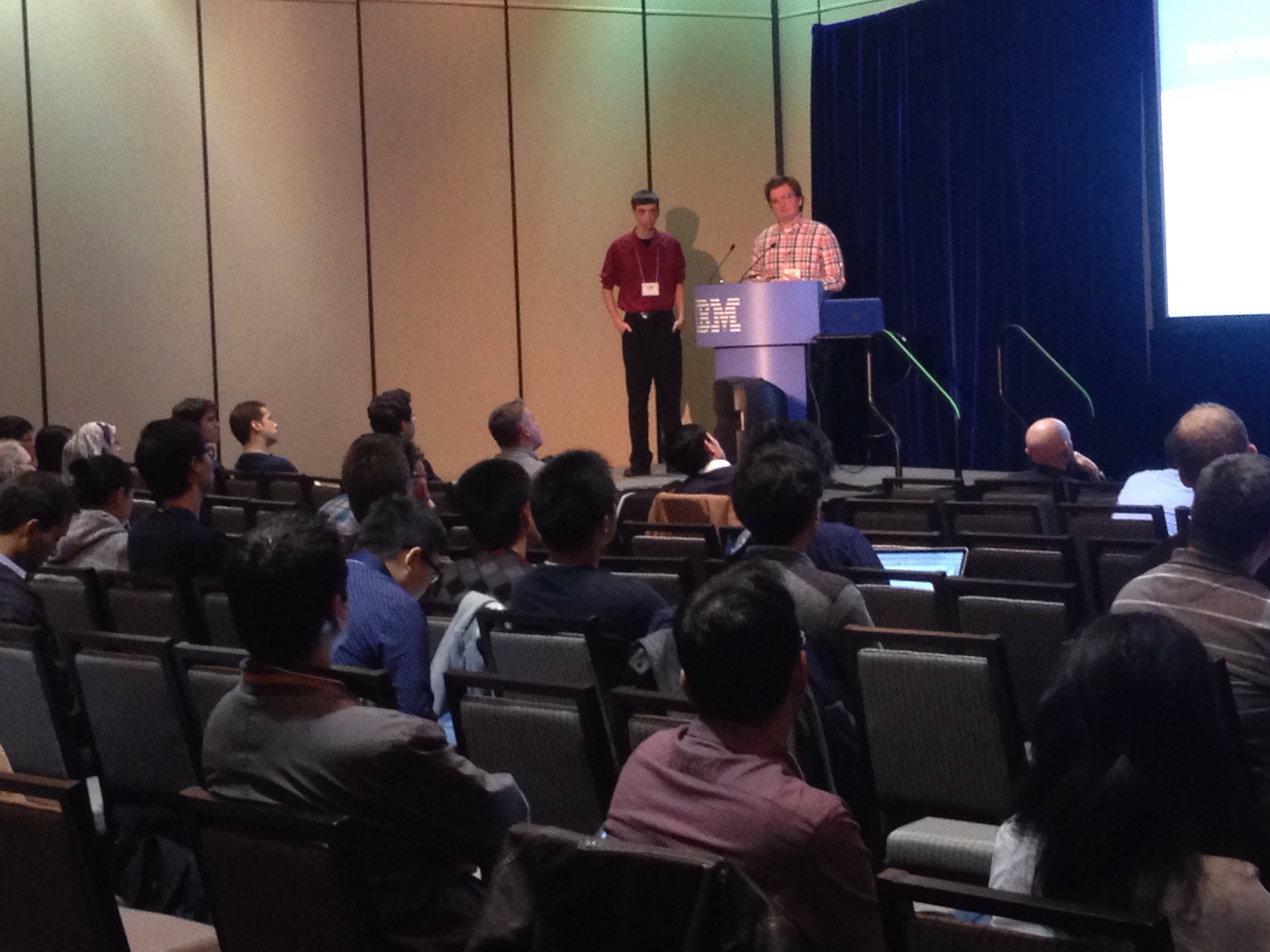
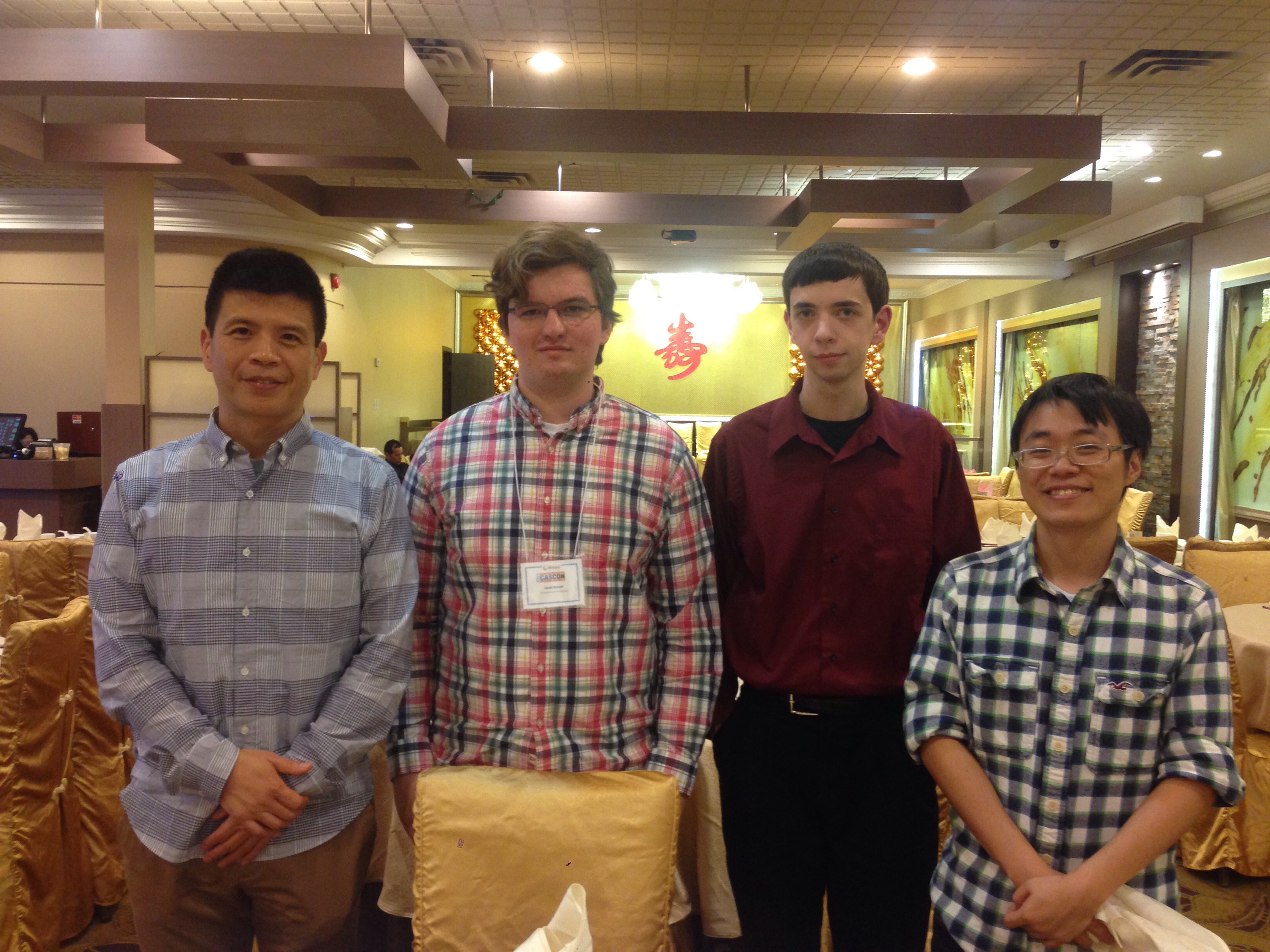
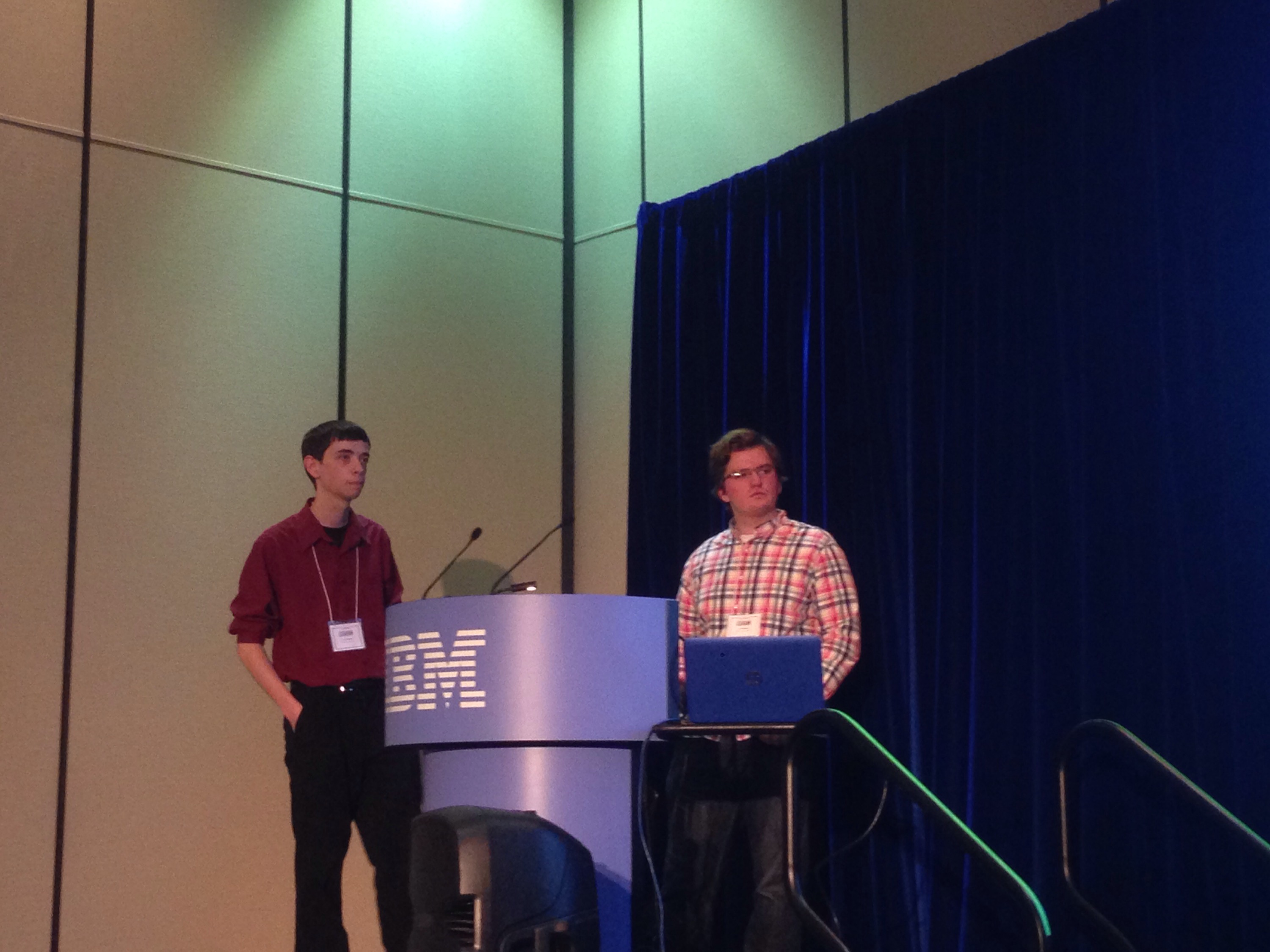
Rochester DandyHacks

3rd spring Hackathon, 120 students, 36 hours, 17 projects, CS and data science.  

Award winners:  http://dandyhacks2016.devpost.com/
Many other good projects and presentations (ones I wrote down): Control-f books.  Droplet. Electric go cart.  Improvs. Vote2eat. Trump tweets. Medbook.tech. Musically.me. Naptimes. Serial port game. Pass the paragraph. Refugestudent.com. Trump bot.  Rhythm fighter. Alg is simple. 3D gesture drawing.   Virtual Tetris.  


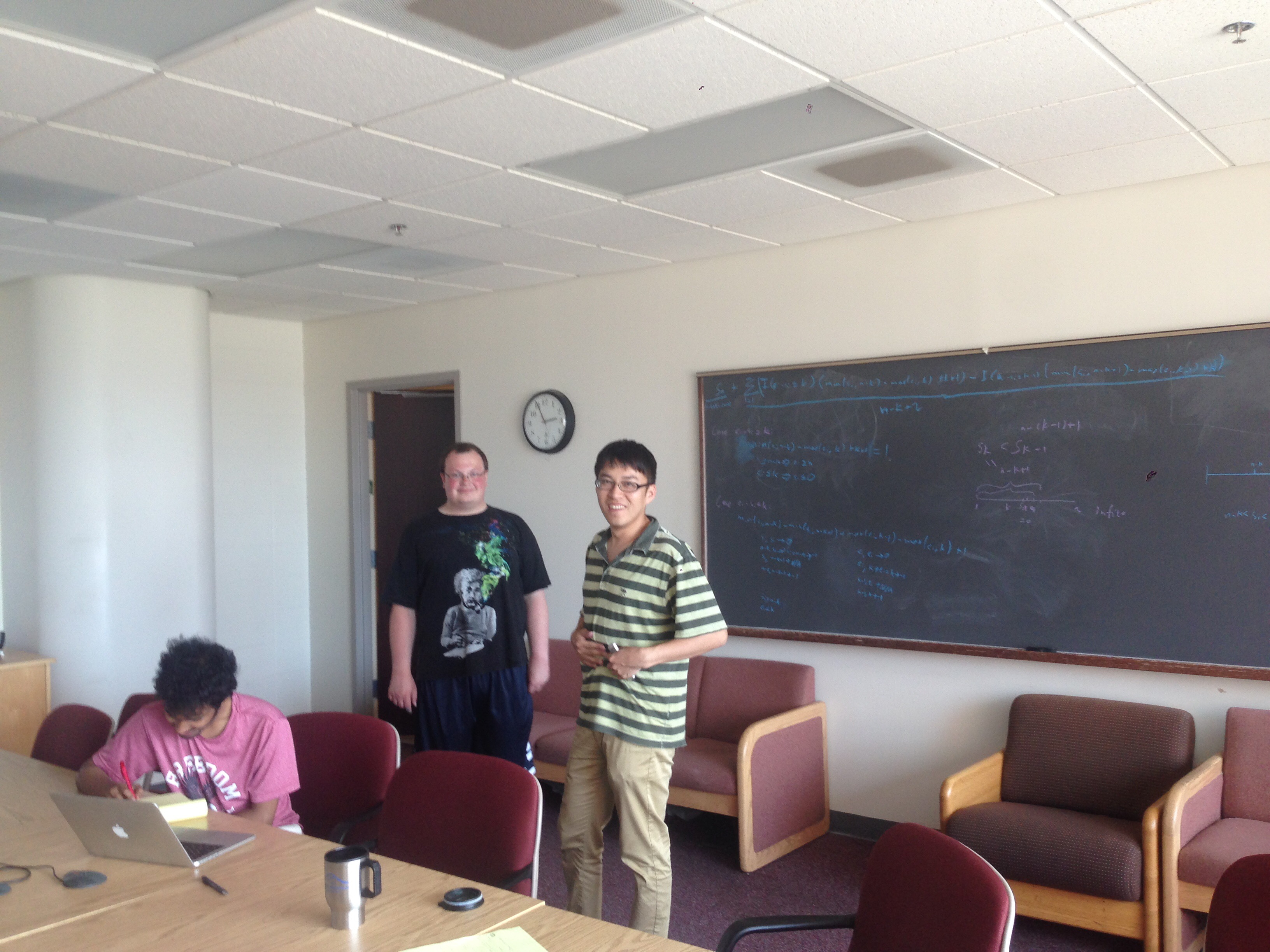
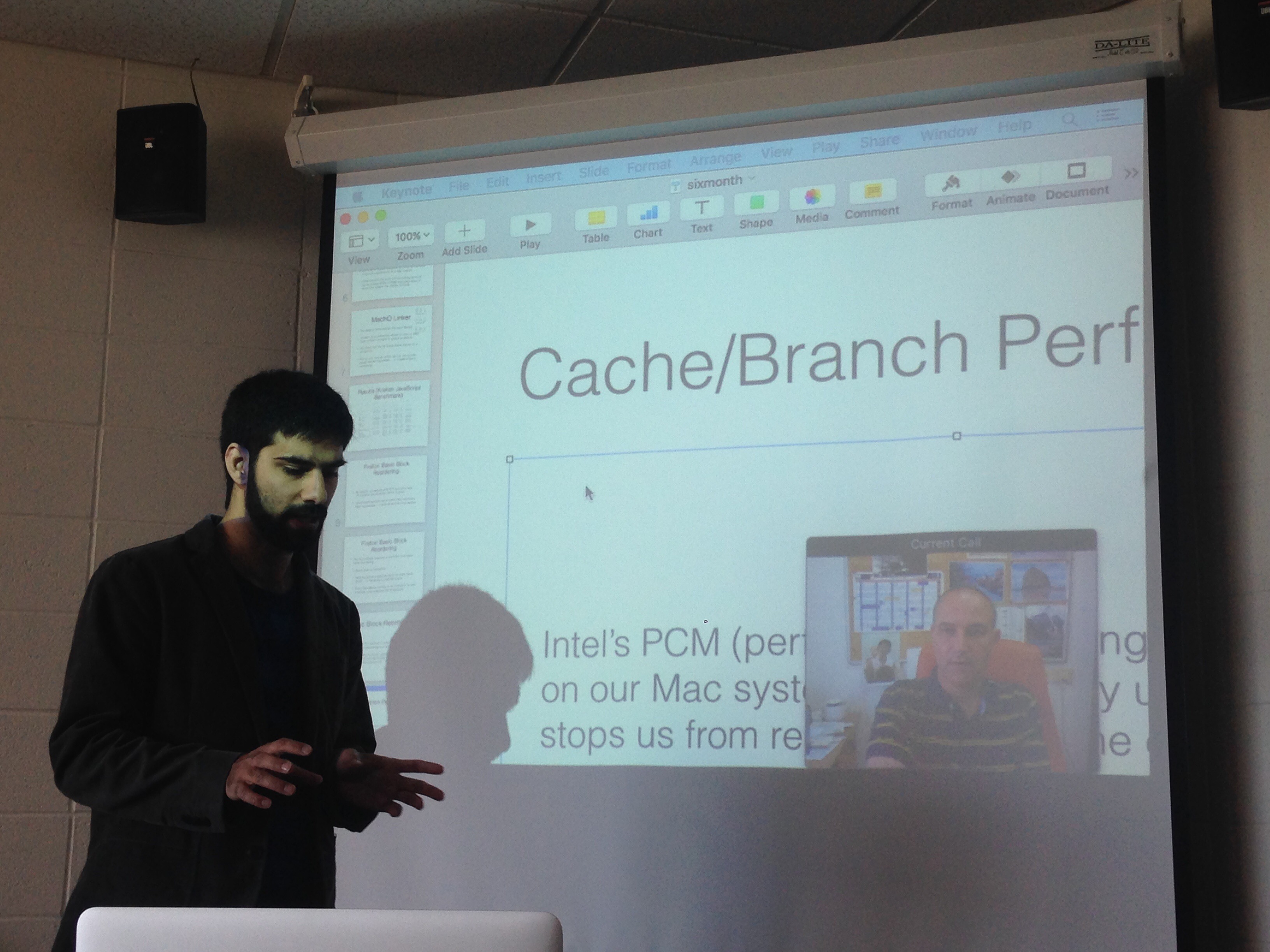
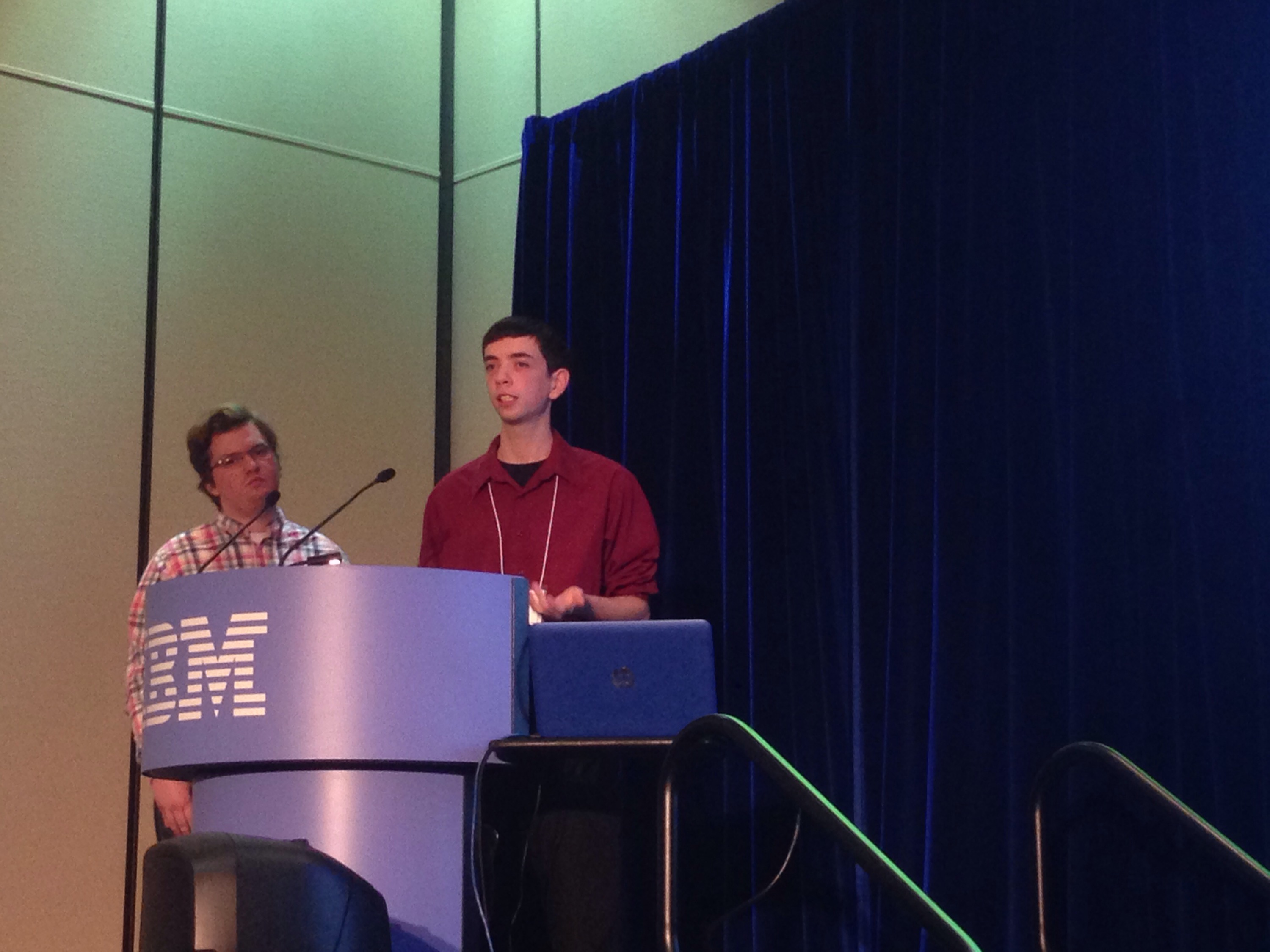
Okay.  The last photo is a joke. 


CS 255/455 Spring 2016

 IMG_2434

CSC 255/455 Software Analysis and Improvement (Spring 2016)

Lecture slides (when used), demonstration programs, and some of the reading material will be distributed through Blackboard.  Assignments and projects will be listed here.


Assignments:

  • def-use in URCC/LLVM
  • LVN in URCC/LLVM
  • CFG pass in URCC/LLVM
  • Instruction counting in GCC/LLVM
  • Local value numbering
  • Trivia assignment.  Read slashdot.org for any current or archived posts.  Select any two posts on a topic of either GNU, GCC, or LVM (both posts may be on the same topic).  Read the posts and all discussions.  Write a summary with 200 or more words for each of the two posts.  In the summary, review facts and main opinions people agreed or disagreed.  Print and submit a paper copy Wednesday January 20th at the start of the class.  Then see me in one of my office hours for feedback on the summary.   There is no deadline for the meeting, but the grade is assigned only after the meeting.  If you see me before submitting the paper, bring your paper; otherwise, don’t since I’ll have your paper.

 Course description

With the increasing diversity and complexity of computers and their applications, the development of efficient, reliable software has become increasingly dependent on automatic support from compilers & other program analysis and translation tools. This course covers principal topics in understanding and transforming programs by the compiler and at run time. Specific techniques include data flow and dependence theories and analyses; type checking and program correctness, security, and verification; memory and cache management; static and dynamic program transformation; and performance analysis and modeling.

Course projects include the design and implementation of program analysis and improvement tools.  Meets jointly with CSC 255, an undergraduate-level course whose requirement includes a subset of topics and a simpler version of the project.


 Instructor and grading

Teaching staff: Chen Ding, Prof., CSB Rm 720, x51373; Rahman Lavaee, TA. CSB 630, x52569.

Lectures: Mondays and Wednesdays, 10:25am-11:40am, CSB 632

Office hours: Ding, Fridays 3:30pm-4:30pm (and Mondays the same time if pre-arranged);

TA Office hours: Wednesdays 3:30pm – 4:30pm, CSB 720.

Grading (total 100%)

  • midterm and final exams are 15% and 20% respectively
  • the projects total to 40% (LVN 5%, GCC/LLVM 5%, local opt 10%, global opt 10%, final phase 10%)
  • written assignments are 25% (trivial 1%; 3 assignments 8% each)

 Textbooks and other resources

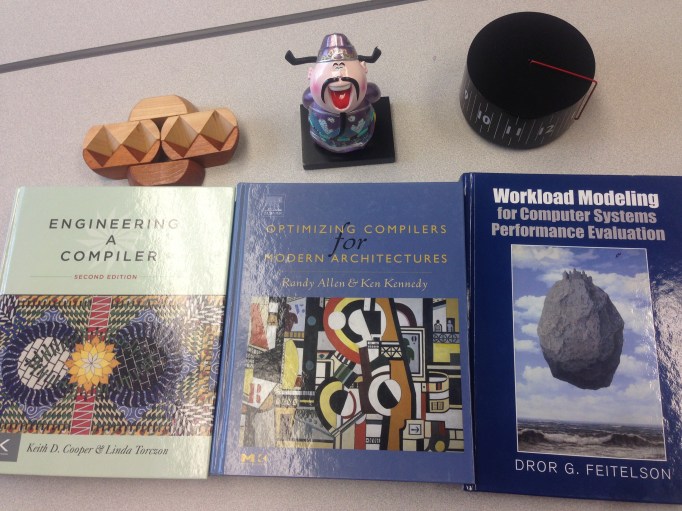
Optimizing Compilers for Modern Architectures (UR access through books24x7), Randy Allen and Ken Kennedy, Morgan Kaufmann Publishers, 2001. Chapters 1, 2, 3, 7, 8, 9, 10, 11. lecture notes from Ken Kennedy. On-line Errata

Engineering a Compiler, (2nd edition preferred, 1st okay) Keith D. Cooper and Linda Torczon, Morgan Kaufmann Publishers. Chapters 1, 8, 9, 10, 12 and 13 (both editions). lecture notes and additional reading from Keith Cooper. On-line Errata
Workload Modeling for Computer Systems Performance Evaluation, Dror G. Feitelson, Cambridge University Press, 2014.   (book pdf for personal use)  Chapters 1, 3.1, 6.2


Shonan Meeting in Japan, November 2015

Putting Heterogeneous High-Performance Computing at the Fingertips of Domain Experts

Organized by:
Wim Vanderbauwhede, University of Glasgow, UK
Sven-Bodo Scholz, Heriot-Watt University, Scotland
Tetsuya Takemi, Kyoto University, Japan

NII Shonan Meeting@ Shonan Village Center, November 17-20, 2015

http://shonan.nii.ac.jp/shonan/blog/2014/10/19/putting-heterogeneous-high-performance-computing-at-the-fingertips-of-domain-experts/

2015 Compiler-Driven Performance Workshop in Toronto 

14th Compiler-Driven Performance Workshop

Wednesday, November 4, 2015

Hilton Suites Toronto/Markham Conference Centre

http://plg.uwaterloo.ca/~olhotak/cdp_2015

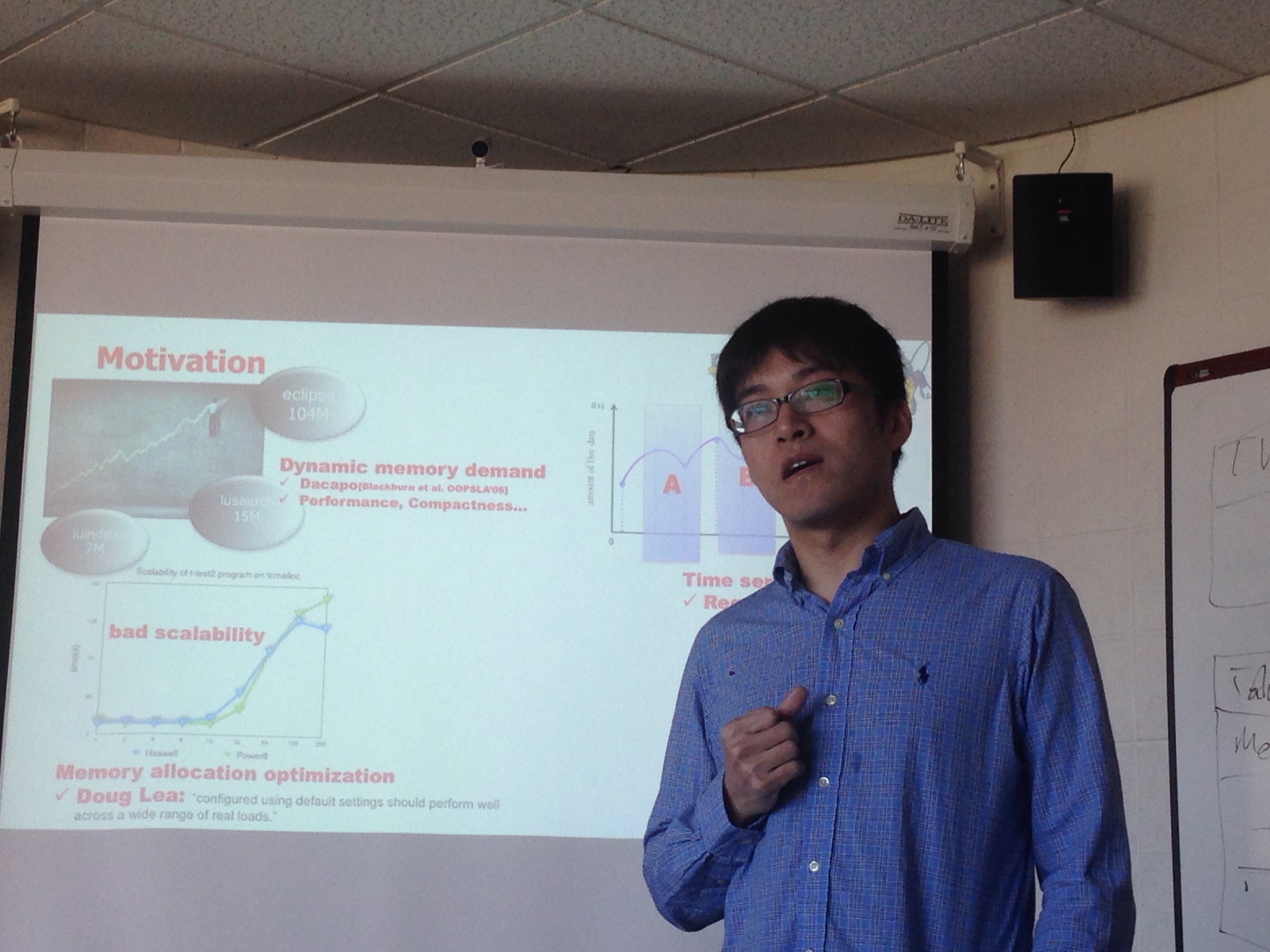
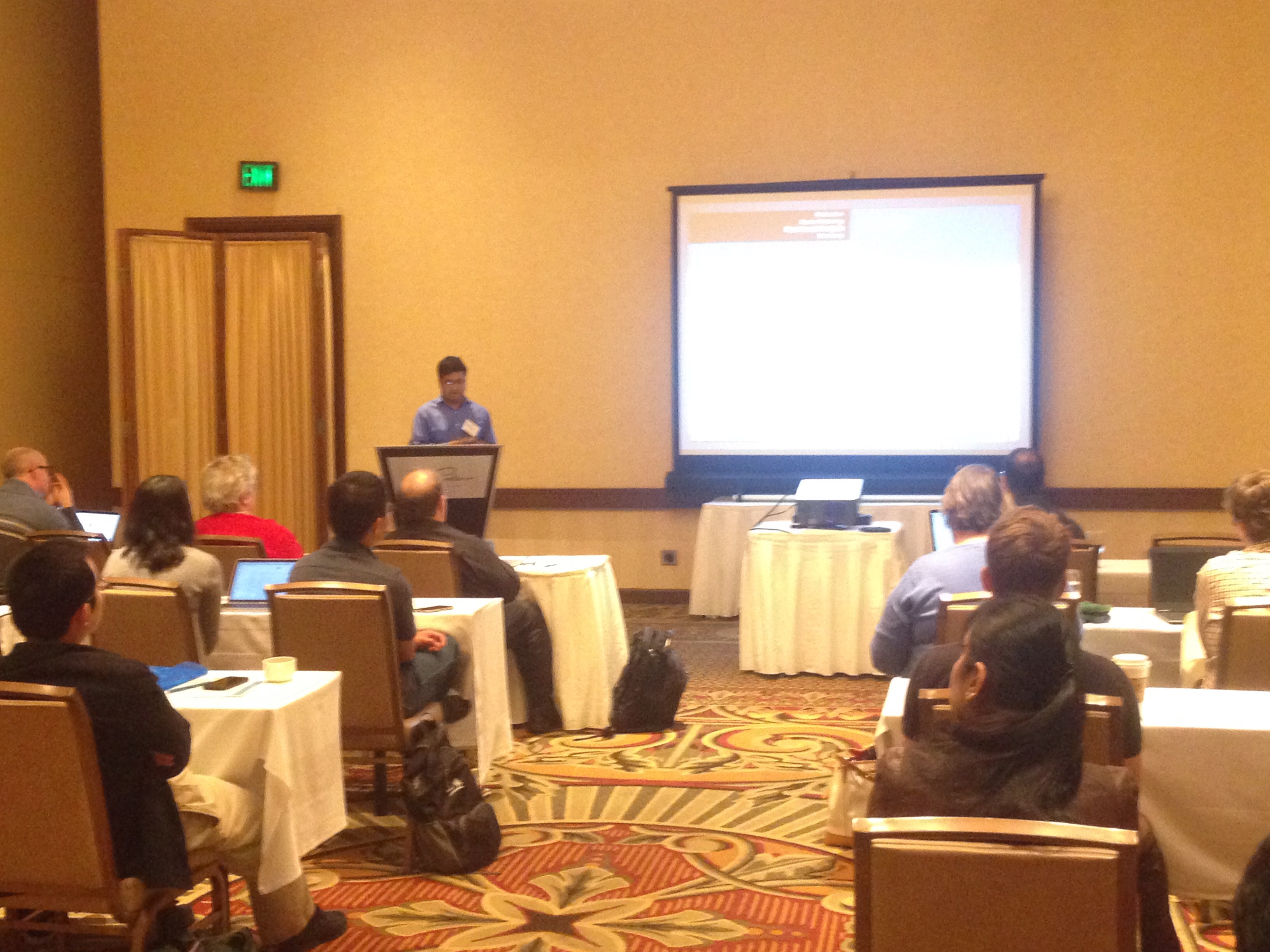
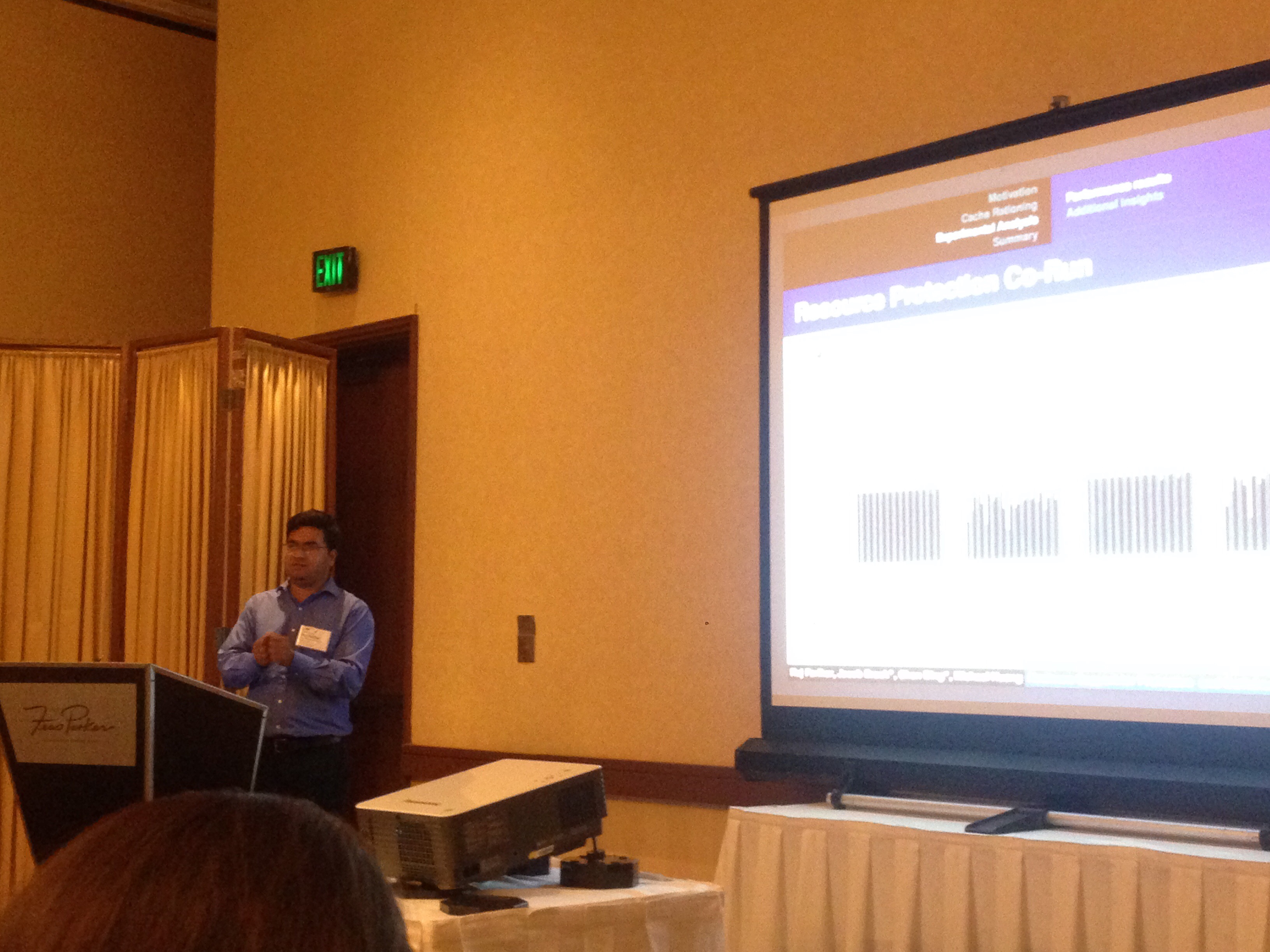
RECU:Rochester Elastic Cache Utility
Chencheng Ye1,2, Jack Brock1, Chen Ding1, Hai Jin1 – 1University of Rochester, 2Huazhong University of Science

See presentation slides at https://roclocality.org/wp-content/uploads/2015/11/recu-cdp15.pdf

RubyBOP: Safe Parallel Ruby
Chen Ding, Jacob Bisnett, Benjamin O’Halloran, Cesar De Hoyos, Brian Gernhardt – University of Rochester
Data-centric Combinatorial Optimization of Parallel Code
Hao Luo, Guoyang Chen, Pengcheng Li, Chen Ding, Xipeng Shen – University of Rochester


Dragon Boat Fusion Cuisine 凱龍船


RubyBOP Introduction

Behavior-oriented parallelization (BOP) provides a suggestion interface for a user to mark possible parallelism and run-time support to guarante correctness and efficient execution whether the hints are correct or not.  It enables program parallelization based on partial information and is useful for incrementally parallelizing a program or streamlining it for common uses.

This page contains a tutorial to introduce RubyBOP to a CS undergraduate student who will become a developer of the system.

Introduction

Modern programs often have dynamic parallelism at the high level but are hard to parallelize because of complex code such as the use of bit-level operations, unrestricted pointers, exception handling, custom memory management, and third-party libraries. Moreover, many programs have input-dependent behavior where both the degree and the granularity of parallelism are not guaranteed or even predictable. For manual parallelization, the complexity and the uncertain performance gain do little to warrant the investment of time and the risk of error.

Behavior-oriented parallelization (BOP) addresses these problems by providing a suggestion interface for a user to mark possible parallelism in a program and a run-time system to guarantee correctness and efficiency. If the hints are correct, the program will run in parallel. If the hints are not correct or the suggested parallelism is too fine-grained, the program still finishes as fast as sequential execution. In both cases, the program produces the same output as the sequential execution without hints. BOP is based on frequent, input-dependent behavior rather than definite behavior. It allows program parallelization based on partial information and is useful for incrementally parallelizing a program or streamlining it for common uses.

Paper Reading

Example (Unsafe) OpenMP Programming

Use the add example.  It computes on the N elements of an array and adds the results together.  It is parallelized in OpenMP.  Use GCC to build it and run it in parallel.   The executable has two parameters: the number of elements to compute (in millions) and the number of blocks (to divide the elements into and compute in parallel).  Change these two parameters and the number of OMP threads.  Observe the performance and the result.  Do you see a non-deterministic error?

C-BOP Manual

RubyBOP source code is a Mercurial repository.  Download it from cycle1.cs.rochester.edu://p/compiler/hg-repos/rubybop/  Here we refer to the root as [repos].

Read the programming manual of C-BOP.  C-BOP is the subdirectory [repos]/cbop/.  It is a C library that a C program can call to parallel the program.

A description of the library API calls is given in the programming manual in [repos]/cbop/prog_man/.  Use a web browser to open the base manual page index.html.  The information may be dated or missing.  We will update and improve the document as we go.

Write the First C-BOP Program

Use the programming manual and the C-BOP source code to parallel the add program using BOP programming hints.

Ruby C Extension

Use the most recent Ruby release (2.2).  Add a new trivial class in C and a public method in the new class to return some number or string.  To test your extension, write a Ruby program, standalone or in the interpreter, create an object of this new single-method class and call the method to check the results.

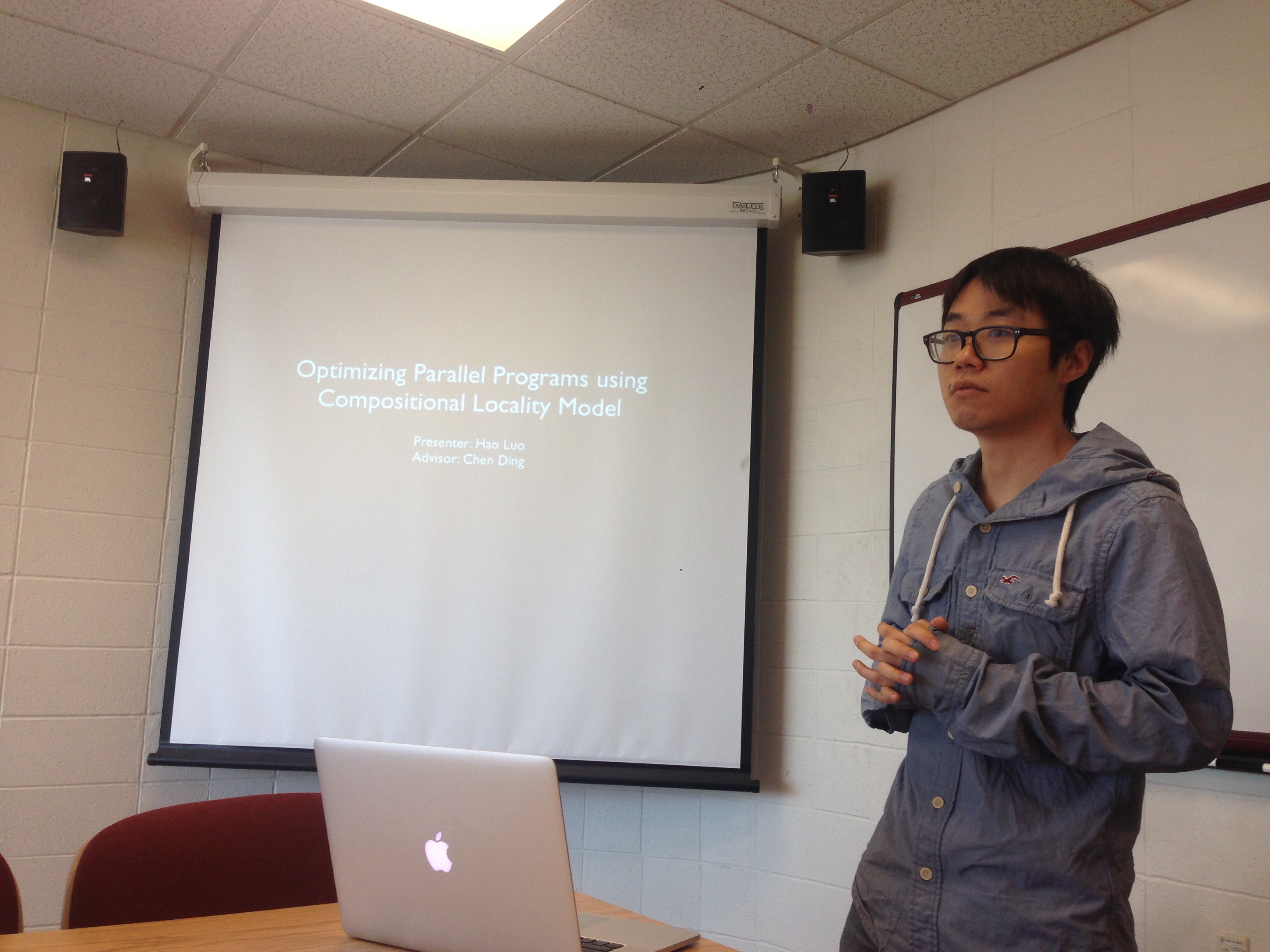
Hao Luo 6 Month Review

Background. Multicore applications share cache. Composable analysis is needed to see how programs interact with dynamic, usage based cache management. Miss ratio/rate doesn’t compose.

Xiaoya’s work. Footprint composes but assumes uniform interleaving.

Jake et al. Common logical time in CCGrid 2015 handles non-equal length component traces, eg. one thread accesses memory 100 times more frequent than another thread. But we still assume uniform interleaving.

Hao repots several advances.

Time-preserving decomposition

Now we can compose threads that have any type of interleaving.

Cache associativity modeling

The Smith method is the dominant solution for nearly 40 years but assumes equal probability of access in all cache sets. Hao’s new solution removes this assumption and uses time-preserving decomposition to also allow non uniform interleaving.

GPU texture cache

Modeled as a sector cache to give composable performance for all cache sizes and associativity as for normal cache.

New studies

Space efficient algorithms for shared footprint analysis.

Possibly memcached or io traces.

Static locality analysis.

Locality aware scheduling

2015/04/img_8535.jpg

3 Techniques of Tree Sampling

At the 2015 University Day organized in the Systems workshop organized by Wang Chen at IBM Toronto, José Nelson Amaral of University Alberta gave a talk explaining the following studies.  The problem is estimating the size of a tree by traversing some but not all nodes.

“Mathematics of computation” by Donald Knuth in American Mathematical Society 1975 gave a sampling solution: Go down random tree paths to the leaves, and take the average of the sampled sub-tree size as the actual average sub-tree size.

Heuristic sampling by Peng Chen in 1992 takes samples but reuses the past results.  It uses the term Stratification but the technique sounds like memoization.  An example is the Fibonacci series.

The Alberta work is to estimate the number of leaf tasks in a recursive fork-join (Cilk) program.  The solution is a complete exploration of the top of the tree until it has the nodes 10 times the number of processors.  Then it uses the Knuth method to estimate the size of a sub-tree.

Another example is 3×3 puzzle, 181,440 states and 4×4, more than 10^13 states.