Announced to undergraduate students in an email on March 18, 2026:
Updated for Fall’26
CSC253 Software Design and AI-assisted Development
Software design is a critical discipline because modern software systems are too complex for any single individual to fully comprehend, yet they must be designed to avoid causing harm to the people they serve. This course focuses on the collaborative construction of software by teams. The curriculum covers:
Design Principles and Practices: Information hiding, software architectures, work assignments, team organization, iterative development, and documentation.
Safe Programming in Rust: Generics and traits, ownership and borrowing rules, safe pointers, modules, and design patterns.
AI Assistance: automated code and test generation, specialization, and coordination by coding agents.
Ethical Principles: Fairness and human fallibility.
Assignments emphasize teamwork in software design and development. Students enrolled in CSC 453 are also required to learn Rust meta-programming.
Prerequisites:
CSC 172 (Data Structures and Algorithms) or equivalent for CSC 253.
CSC 172 and CSC 252 (Computer Organization) or equivalent for CSC 453.
This week, billions of people, 1.4 in mainland China, are enjoying their longest holiday of the year. It is a tradition time to reflect, mark an entry in this juncture in time, and share with others. With that spirit, here are my thoughts on the fifth day of the Year of Horse.
A recurring theme in traditional Chinese drama is the contrast between those who help others in urgent need and those who only add to the wealth of the rich. This sentiment appears in the book Slapping the Table in Astonishment (Part One), published around 1627—roughly 200 years after Zheng He’s ocean voyages. The original text reads:
This translates to: “In this world, few help those in desperate need, while many add to the fortunes of the already wealthy. Thus, the wise observe: ‘There are always those who gild the lily, but who brings charcoal in the snow?’ These words capture the true nature of human relationships.”
The idea of helping others—going out on a snowy night to deliver firewood to those without heat—once defined my understanding of charity. Before coming to Rochester, I believed that was exactly what charity meant: helping others. Living in Rochester, however, my perspective has changed.
Rochester has a rich legacy. In 1960s and 70s, the “Nifty Fifty” stocks are a group of high-growth, large-cap stocks popular with institutional investors and widely regarded as “one-decision”, that is, buy and never sell. Three of these are in Rochester: Kodak, Xerox, and Bausch & Lomb. George Eastman, who founded Kodak, had a wealth of $100 million (2 billion today) and gave most of it away: $50 million to University of Rochester including Eastman music school and $20 million to MIT (anonymously as Mr. Smith). In his late years, he suffered from a health condition which was extremely painful. After touring the new River Campus of University of Rochester, accompanied by then university president Rush Rhees, he returned home and committed suicide, leaving a brief note: “To my friends: my work is done. Why wait? G.E.”
Rochester is cited as the birthplace of the modern United Way movement. “Checking a box” on a payroll deduction form to donate and support the community is a direct descendant of this tradition. If just visiting, one would not see a difference, but living here for decades, I know how unusual for a city to have a deeply ingrained culture of giving back. Since around 2010, a few years after our second child was born, my family has been donating the equivalent of one dollar per person per day to United Way. In 2025, approximately 50,000 people donated about $16.7 million to this organization alone. The funds are used to support programs run by local charitable organizations. Many people, including us, also donate directly to these groups. I know people who volunteer in these programs. For example, one of our children’s music teacher and her husband volunteer one day each week doing cleaning work at Ronald McDonald House. The picturesque house sits by the canal and a short distance from the UR Hospital, with 24 private bedrooms to house terminally ill children, at no cost to their families. I feel fortunate to be able to donate to United Way and support volunteers who help others. But this is still not the whole meaning of charity.
Today I saw a passage by Vincent van Gogh, who wrote in 1882 to his brother Theo Van Gogh (who supported him through his life and died only 6 months after Vincent died).
What am I in the eyes of most people — a nonentity, an eccentric, or an unpleasant person — somebody who has no position in society and will never have; in short, the lowest of the low. All right, then — even if that were absolutely true, then I should one day like to show by my work what such an eccentric, such a nobody, has in his heart. That is my ambition, based less on resentment than on love in spite of everything, based more on a feeling of serenity than on passion. Though I am often in the depths of misery, there is still calmness, pure harmony and music inside me. I see paintings or drawings in the poorest cottages, in the dirtiest corners. And my mind is driven towards these things with an irresistible momentum. I’m seeking. I’m driving. I’m in it with all my heart. What would life be if we had no courage to attempt anything. (based on translation used by @soulxsigh on TikTok)
Here is what charity truly means: It is not only about helping others—it is also about allowing ourselves to be inspired. Whether it is someone enduring a cold winter night without heat, someone donating their time to lift others up, or someone uncompromisingly charting their own life path, we draw inspiration from them. And we will not be the only ones who find new strength and meaning in their example. A life well lived is one filled with moments of inspiration. In this light, our charity is simply investing our wealth to live a better life—first and foremost for ourselves.
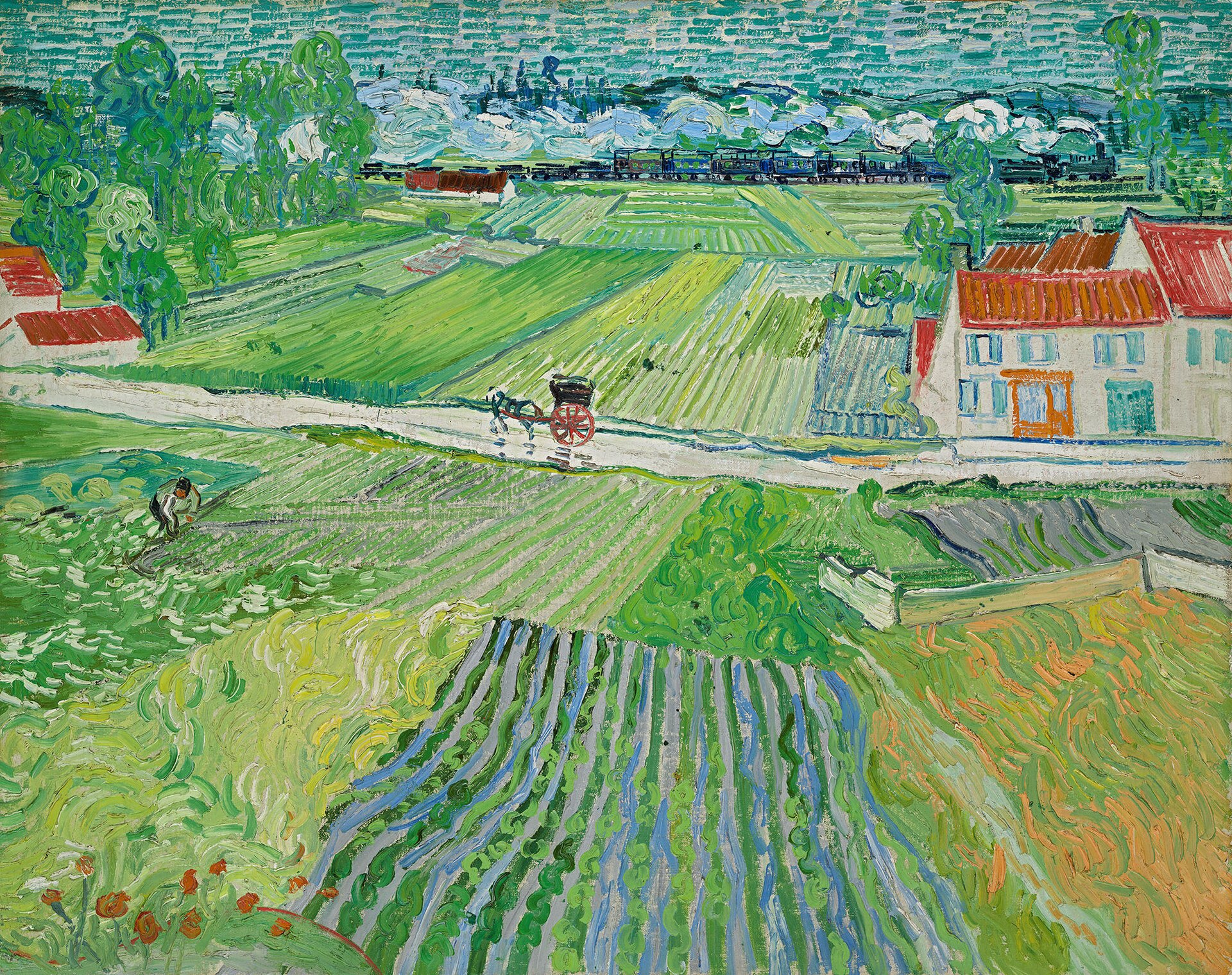
Below is van Gogh’s painting titled Landscape with a Carriage and a Train, with a horse in the center (Source: https://en.wikipedia.org/wiki/Landscape_with_a_Carriage_and_a_Train). Wishing everyone a happy time in the Year of the Horse. 马到成功 (Mǎ dào chéng gōng) — may you succeed in arriving.
Fun fact: In 2020, Rochester United Way received a record $35 million donations. The unusual total is due to the historic $20 million gift from MacKenzie Scott.
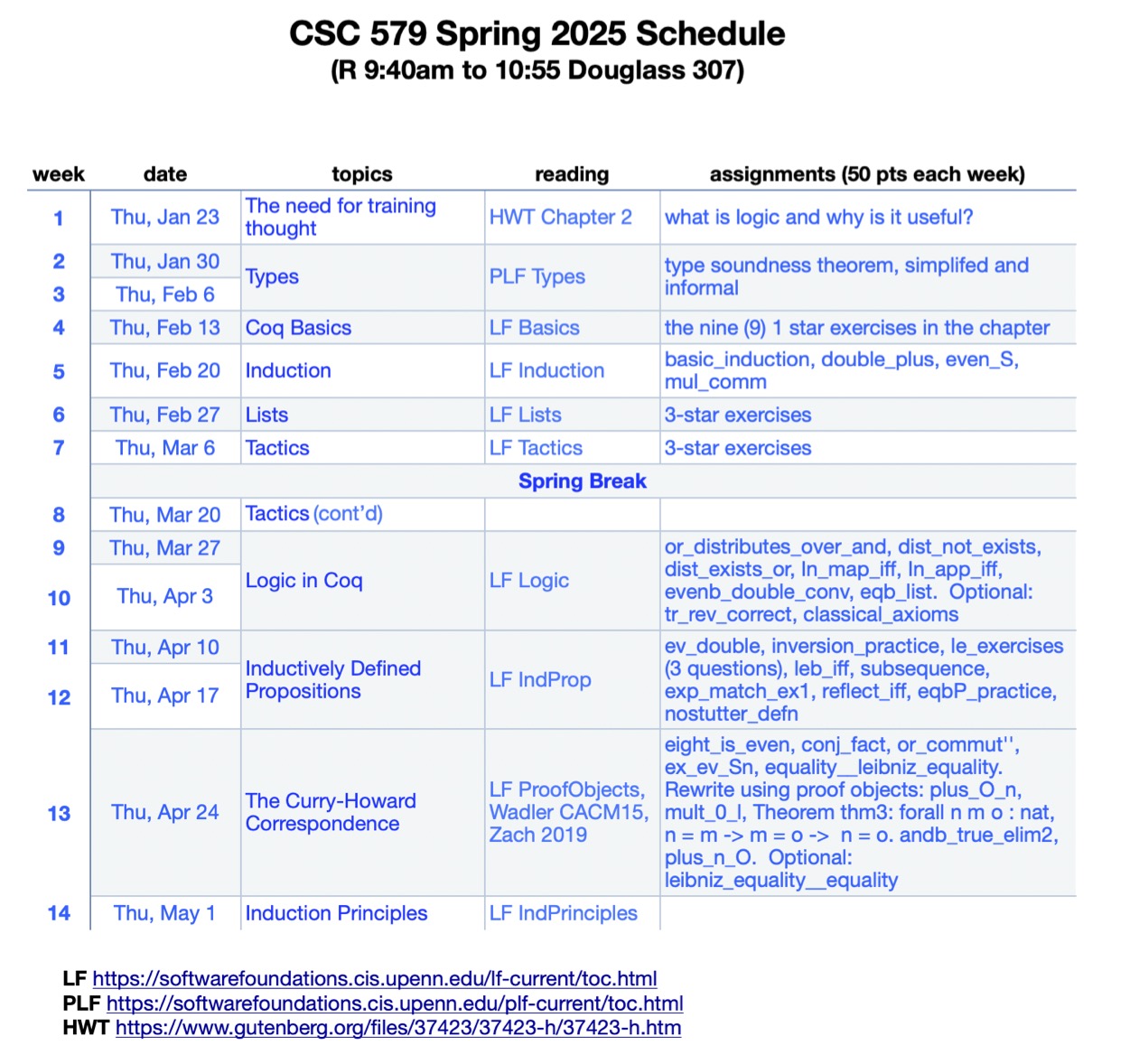
CSC 579 Spring 2026 (R 9:40am to 10:55 Wegmans 1005)
The language of intelligence is logic. The course teaches proof systems, with a focus on Coq. You will learn to use Coq to formalize logic, which is the fundamental language of rational thought and problem-solving, and construct sound and verifiable proofs. A similar system, Lean 4, was used by generative AI, Alpha Proof, to solve Olympiad-level math problems. By learning the fundamentals of modern proof systems, you acquire a complete foundation for logical thinking and the knowledge and skill to use or build automated reasoning systems.
Pre-requisites: Students enrolling in the course are expected to have advanced knowledge in either programming languages (CSC 253, 254 or 255), math, or logic.
Syllabus
The Need for Training Thought: The Values of Thought. Tendencies Needing Constant Regulation. Regulation Transforms Inference into Proof.
Type Systems. Operational Semantics. Progress. Type Preservation. Type Soundness.
Functional Programming in Coq: Data and Functions. Proof by Simplification, Rewriting and Case Analysis.
Proof by Induction. Proofs Within Proofs. Formal vs. Informal Proof.
Logic in Coq. Logical Connectives: Conjunction, Disjunction, Falsehood and Negation, Truth, Logical Equivalence, Logical Equivalence, Existential Quantification. Programming with Propositions. Applying Theorems to Arguments. Coq vs. Set Theory: Functional Extensionality, Propositions vs. Booleans, Classical vs. Constructive Logic.
Inductively Defined Propositions. Induction Principles for Propositions. Induction Over an Inductively Defined Set and an Inductively Defined Proposition.
The Curry-Howard Correspondence. Natural Deduction. Typed Lambda Calculus. Proof Scripts. Quantifiers, Implications, Functions. Logical Connectives as Inductive Types.
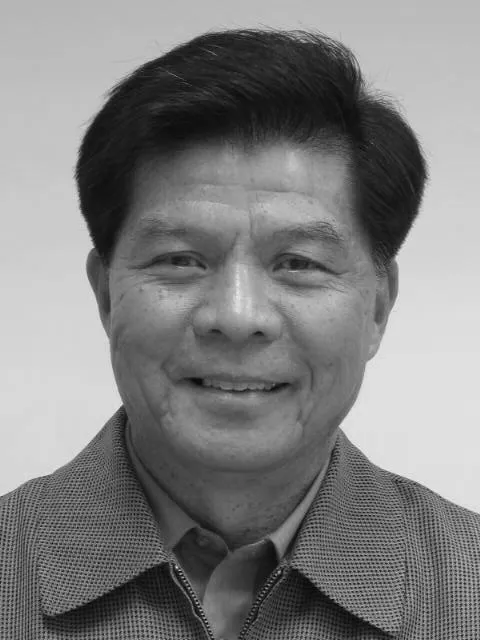
Professor Tang was my undergraduate thesis advisor three decades ago. He passed away on Tuesday. Below is the English translation of the main passages of the article on Thursday in China’s Guangming Daily, full text in Chinese at https://mp.weixin.qq.com/s/JzjPkV0MMUjhlfibbRLNyw
Professor Tang Shiwei was born in December 1939 in Ningbo, Zhejiang Province. He graduated from the Computational Mathematics program of the Department of Mathematics and Mechanics at Peking University in 1964 and remained at the university to teach after graduation. He was promoted to professor in August 1990 and retired in December 2004.
Professor Tang Shiwei was a founder of the database as an academic discipline in China. He long dedicated himself to teaching and research in databases and information systems. He served as Director of the Database Research Laboratory in the Department of Computer Science and Technology at Peking University, Director of the Peking University Computing Center, Director of the Information Science Center, Director of the National Key Laboratory of Visual and Auditory Information Processing, Vice Chair of the Database Professional Committee of the China Computer Federation, and Professional Advisor to the Beijing Municipal People’s Government, making significant contributions to the development of computer science research and education in China.
At Peking University, he spearheaded the development of China’s independently copyrighted database management system, COBASE and the domestic system software platform COSA, for which COBASE was a key component and received a national award in 1996.
Original text in Chinese by Jin Haotian (晋浩天), correspondent, Guangming Daily
I took the database class around 1993, taught by his colleague Professor Yang, Dongqing (杨东清) and then joined their research group for my undergraduate thesis. I remember Professor Tang mentioning to me that they were the first in China to learn the development of databases in the US including reading the source code of early database systems. As a student assistant, I was sent to visit the Bank of China and talk to to account operators. It was pretty much deaf-mute conversation — I knew the textbook but nothing about applications let alone banking, but at the time I thought I was there to tell them what to do. Later a senior graduate student went to redo the visit. I was given part of the consulting fee even though my contribution might have been negative. Professor Tang was most generous and encouraging to me. I am fortunate and proud to be a part of his legacy.
Professor Tang also directed the undergrad thesis of Yuanyuan Zhou, now a professor at UCSD.
Dear Colleagues, parents, guests, and most important, our graduates:
Welcome to the 2025 CS graduation ceremony. I’m the department chair Professor Chen Ding.
Our 150 bachelor graduates and 30 MS graduates, here and elsewhere, you make today special: not just the day of graduation, but also the day we graduate the largest class in the department’s 50-year history.
At a commencement 20 years ago, David Foster Wallace told a parable: Two young fish swimming along, and they happen to meet an older fish swimming the other way, who nods at them and says, ‘Morning. How’s the water?’ And the two young fish swim on for a bit. Then one looks at the other and asks, ‘What is water?’
Parables are open to interpretation. So what is water the pervasive medium shaping our life? It is tech and increasingly CS. Computing principles drive every aspect from hardware to software to application. Blockchain, quantum computing, and autonomous driving all emerged from CS research. According U.S. Labor Statistics, over 60% of STEM jobs require CS skills. CS is transformative in other fields too. In this class, 96 undergrads, or almost two-thirds, took another major or minor.
Before going for his PhD, a student of mine plans to traverse the Continental Divide from El Paso, Texas, to Banff, Canada. Let his journey be not a symbol but embodiment of the grueling work of learning you did in the past and the daunting uncertainty of future you may be facing now.
Marcus Arellius said: Impediment to action advances action. Think 2700 miles, on a bike, alone, and camping under open skies. What stands in the way, becomes the way. Every challenge and setback is not blocking your path. It is the path. Our muscles strengthen, and our brain forms strong neural path ways when we work through our difficulties, none when things are easy.
You have done the hard work. What is the future?
CS is the engine of innovation. So much we have today did not exist even last year. This SSD card, a stamp in size, not much thicker, stores 1TB data. A question for parents and guests: raise your hand if you have used ChatGPT? An open-source equivalent is DeepSeek. You can download its data. The full model is 1TB. Most things we ask on Google you can now ask on ChatGPT or DeepSeek. Hence, information equivalent to Google Search is literally at my fingertip.
The power is immense majestic and terrifying. We see increasing inequality and political polarization at home, conflicts and wars abroad. CS is not innocent. Do you realize that we are the last generation who lived before social media? This little card tokenizes either human knowledge with unlimited potential or an existential threat, the ultimate FOOBAR.
This brings me to my final point, a last lesson if you will. A principle I teach in collaborative software design is that we are all fallible. Software is designed by people for people. Moral and human questions are infinitely more complex than math and science. There is no logical or mathematical certainty. The truth depends on a balance between two sets of conflicting reasons. It is crucial that you listen to people with whom you disagree, so you can go through the same mental journey they took to their conclusion. Quoting JS Mill: “In the human mind, one-sidedness has always been the rule, and many-sidedness the exception. Therefore, open our minds to listen to our opponents, thank them to do for us that otherwise we ought to do for ourselves.
To recap, everyone is fallible. We approach truth best by working together.
Speaking on behalf of all faculty and staff, congratulations. We will watch you with joy and pride. And we will always be here when you return to visit.
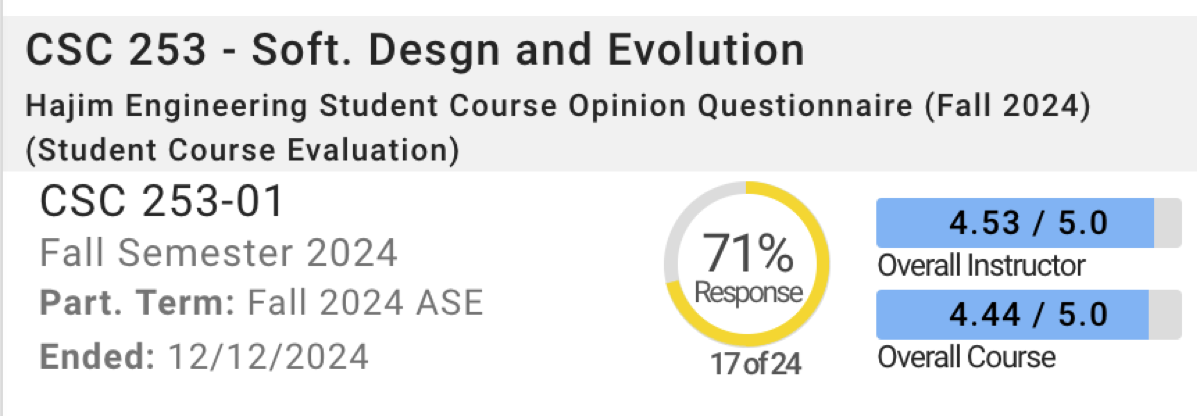
Anonymous inputs were collected by the university before the final exam. 17 out of 24 students (71%) submitted the evaluation.The overall Instructor Rating is 4.53, and the overall Course Rating 4.44.
Two anonymous comments:
Professor Ding is a great professor and a strong proponent of Rust. Taking his class has introduced me to many benefits of Rust and broadened my horizon on collaborative programming, software design, and software testing. I believe acquiring these knowledge is beneficial for me and my teammates (it goes both ways) on the long run.
The final DVCS group project workload is very imbalanced and hard to control. Some group members even disappeared during the last half of the project.
Logic in Coq. Logical Connectives: Conjunction, Disjunction, Falsehood and Negation, Truth, Logical Equivalence, Logical Equivalence, Existential Quantification. Programming with Propositions. Applying Theorems to Arguments. Coq vs. Set Theory: Functional Extensionality, Propositions vs. Booleans, Classical vs. Constructive Logic.
Inductively Defined Propositions. Induction Principles for Propositions. Induction Over an Inductively Defined Set and an Inductively Defined Proposition.
The Curry-Howard Correspondence. Natural Deduction. Typed Lambda Calculus. Proof Scripts. Quantifiers, Implications, Functions. Logical Connectives as Inductive Types.
It is my pleasure and honor to succeed Michael Scott as the chair. We are an elite research department in a private university that excels in undergraduate education and advanced research. Our faculty size, 21 tenure track and 6 instructional, is substantial in size to lead research and teaching across broad topics in AI/HCI, systems, and theory, yet small enough to operate by consensus. This combination of size and strength is unique, making it the best department for me for over two decades. My goal for the three-year term is to maintain its quality, spirit, and momentum.
This is the year the department turns 50 and simultaneously grows young again. The department has grown steadily under Michael’s stewardship in the past four years, and Sandhya Dwarkadas’s before that. For the first time in over two decades, junior faculty outnumber senior faculty. The staff size is at an all-time high, and most administrative staff are recent hires.
As part of the Meliora weekend, we celebrated our 50th anniversary with morning talks, an afternoon meet-and-greet, and an evening reception at the Hawkins-Carlson room at the library. Registration was beyond capacity for all three events, and the evening cocktail party was standing-room-only with a full house. Thanks to all who came to the celebration, especially our four keynote speakers: Danny Sabbah reminisced about how he fell asleep in his breakfast bowl after the grueling first-year exams; Amanda Stent defined modern AI as solving problems unsolvable by algorithms and then took questions for 24 minutes; Chris Stewart was as inspiring in his work, digital agriculture, as he was to me when he was in my advanced compiler class; and Michael Scott more than anyone embodied the department’s distinguished identity and stature, with grace and humor.
In the last year we have graduated 123 students with BA and BS degrees, 26 MS degrees, and 3 PhDs. While the PhD count is low after last year’s 20, two recent graduates started tenure track professorships, Jie Zhou (MS ’17, PhD ’23) at George Washington University and Michael Chavrimootoo (BS ’20, PhD ’24) at Denison University. Both worked with me on research prior to their successful PhD work – Jie Zhou on secure computing systems, directed by John Criswell, and Michael Chavrimootoo on computational social choice, directed by Lane Hemaspaandra. Michael also runs half marathons.
In technology, this is the year of generative AI. URCS was founded as an AI department, with five AAAI fellows on faculty over the years, including Henry Kautz, who was AAAI President from 2009 to 2014, and Len Schubert, who retired this summer after 37 years on the faculty most prominently in the field of common sense reasoning. The research of over half the department’s faculty is related to AI, with six professors specializing in core areas of statistical AI such as computer vision, natural language processing, graph neural networks, and machine learning theory, and teaching in these subjects. Next year, we plan to hire at least one additional AI faculty member.
We are teaching a large number of students about AI. By my count, in the third week into Fall 2024, the department is teaching ten advanced courses (200 level or higher, 13 of which are cross-listed) to a total of 491 students, including 129 in CSC 242 Introduction to AI taught by Thaddeus Pawlicki; 99 in CSC 245/445 Deep Learning by Chenliang Xu who created the course in 2017; and 23 in CSC 511 Large Language Models, new this year created by Hangfeng He. Additional courses are offered by Data Science and Brain and Cognitive Science and have CS course numbers.
Every year, our undergrads compete in the International Collegiate Programming Competition (ICPC). This year’s lead team consisting of Zeyu Nie ’24 (computer science and applied math), computer science master’s student Xiaoou Zhao, and Yan Zou ’27 (computer science) placed third in the regional, behind MIT and Harvard, and 17th in the North American Championship, just behind Michigan and Cornell. Despite competing against primarily schools with vastly larger CS programs, our students won their spot in the World Finals. In national contests, CS junior Cole Goodman won the NCAA Division III championship and qualified for the US Olympics Team Trials. Cole is the first Rochester student to do so since 1988 and the only athlete who has taken my course and learned computer organization and RISC-V assembly programming.
The department continues to work to broaden CS participation. Among the activities, ten students, led by our newest faculty member Yanan Guo, attended the Grace Hopper Celebration in October in Philadelphia, the largest gathering of women technologists worldwide. One month earlier, Fatemeh Nargesian led a ten-student group to San Diego, the largest in the department’s history, to the Tapia Conference, which annually brings together students, researchers, and professionals in computing from all backgrounds and ethnicities.
Last but not least, this is the year of charity giving. Danny Sabbah established the first endowed professorship in Computer Science with a generous $2M donation. Rick Rashid started the CS50th fund with a contribution of $100K. Since September 1, 2023, forty-seven other donors, mostly our graduates and their family members, have contributed a total of $38K. Charity is good for the soul. Intelligence may be mechanized, but the soul is uniquely human. The generous financial support is a confirmation from our alumni and others who care about the department, its mission, and its direction.
All that we do draws inspiration and strength from our alumni and friends. We are grateful for all your support.
This is a course required for the Bachelor of Science degree in Computer Science at the University of Rochester. A graduate must understand in depth the underlying physical reality which the virtual world including AI is built and depends on, i.e. the fundamentals of modern computer organization, including software and hardware interfaces, assembly language and C programming, memory hierarchy and program optimization, parallelism and operating systems. The textbooks are listed here.
There are two aspects for such a course in an elite research department like mine. First, the teaching focuses on fundamentals and goes in depth, which sets a high standard but this requirement is necessary for students to learn advanced subject courses later. Second, the material is updated often and part of it even experimental. In prior semesters, my colleagues Prof. John Criswell has emphasized on assembly and operating systems, Prof. Yuhao Zhu on gates and circuits, and Prof. Sree Pai on automatic (bit operation) correctness checking. My main change is the ISA.
RISC-V Instead of x86
Instruction Set Architecture (ISA) is essential in a BS CS degree and must be learned in this course which may be most hated material by a good number of students especially who have no prior knowledge of computer hardware. In my ancient PKU years, I learned Zilog Z80 (a microcontroller) and taught MIPS (classic RISC) and x86 (Intel/AMD) last time in this course in 2012. For the 2024 course, I evaluated Arm (Apple silicons) and the newest RISC-V. RISC-V is “open-source hardware” which means free for anyone to use. The course has the room to teach just one ISA; otherwise students will rebel.
I had a year to prepare for the course and tested this idea first before deciding on this significant change — This year’s students were the first (in Rochester) to learn RISC-V.
My NSF project with RIT has synthesized a RISC-V processor (papers here and here). I consulted my RIT collaborators who told me “x86 is too complex”, Arm is better but has “a lot of corner cases”, and for RISC-V, “I like it enough.” I learned about RISC-V over the years from computer architects to know the ISA is a good design, e.g., the first time in ASPLOS PC in 2019, but the RIT feedback made me think that the ISA is practical and learnable. The next question is whether it is teachable in a required undergrad class.
I purchased five or six single-board computers in both Arm and RISC-V and have them installed. Department staff Ian Ward installed Linux on Lichee-Pi 4A which has a quad-core processor, a GPU, and 8GB RAM for $130. The Arm processor (Raspberry Pi 4A) is weaker and does not run Linux.
My graduate TA Yifan Zhu (SchrodingerZhu on GitHub) installed the complete tool chain to compile and run RISC-V programs (in QEMU) on undergrad server (Intel) machines.
I found the 2024 textbook on RISC-V as recommended by the RISC-V foundation. The book reads well and covers the core knowledge: data representation, binary file and assembly, registers, data movement and control flow, application binary interface (ABI), all in 100 pages.
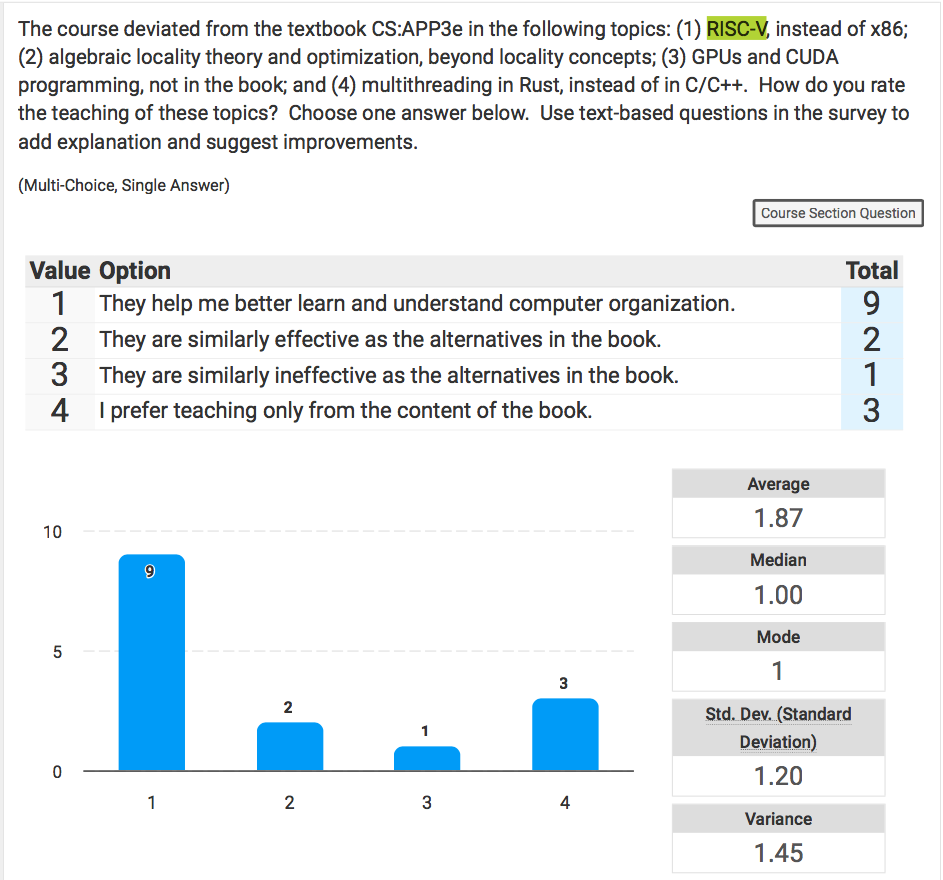
Here is the result. I summerized four changes in the following question (I created) in the Course Evaluation. Here are the question and the 15 responses:
RISC-V is newer and better designed, first with a core and then a series of extensions. The book covers RV32I, the core ISA. It is challenging to learn but learnable, unlike x86 which is too unwieldy, but it is 100 pages of material. Many students read the book and learned. They crossed a threshold of knowing the complete core, which they cannot do from learning x86.
Reading Books instead of Studying for Exams
At last semester’s CS Undergrad Town Hall where most CS faculty sat to listen to students’ feedback. One is that the department changes instructors of a course, and the exams are completely different from past years. I responded that a course teaches a subject, not a subject taught in a particular way and definitely not just exams. Exams are not the goal of learning or teaching, they are the feedback for both students and their teacher.
For this course, Prof. Zhu has made available past exams, problem sets, and their solutions (which I linked to in my course page). One can learn by studying these but shouldn’t use them as the primary source. Instead, students should learn by reading the textbooks. An important use of my lectures is to motivate students to read, show organization so they have mental map going in, and explain tricky/difficult examples and parts. When I find students don’t read textbooks, I use the lecture to read the book with them. My goal is for students to read the book and read it multiple times. The RISC-V book has the full content, updated, and readily accessible online.
The next and last 25 pages of the RISC-V book covers system-level programming (not covered in the course) but reading them (if/when they need to) would be a breeze once a student reads the first 100 pages.
In-person instead of Off-line Grading
The class has 64 students. 89 students registered, 21 dropped, and 5 withdrawn. Multiple students told me that they liked the course but felt not sufficiently prepared and will take the course next semester.
I myself cannot give every student the time and attention they deserve. There is no self deception/illusion/delusion here. I hired seven undergrad TAs. To maintain consistency, they must be primarily responsible for grading. The last thing I should do is to cherry pick and over rule their work.
There are two challenges to project grading. Computer organization is standard material, and the solutions of pass assignments and projects are abundant on the Web. One may say that students who choose to copy solutions waste their time and learning opportunity so who cares, but these are young minds that are often immature, so I do care to at least make it hard for them to fall. Using RISC-V reduces the severity of the problem.
The new problem is ChatGPT and other AI tools which could program in RISC-V. My TAs solved the problem with in-person grading. Students are divided into four groups and come to a TA session each week. They were required to explain their solution. In home work, students wrote and ran RISC-V programs using an emulator. At grading time, TAs set up an actual RISC-V machine so students saw their programs running native and for real.
In one project, the binary bomb, Yifan created the setup that students had practice bombs but when they came to grading, they were given a new bomb to defuse in 15 minutes.
The Result
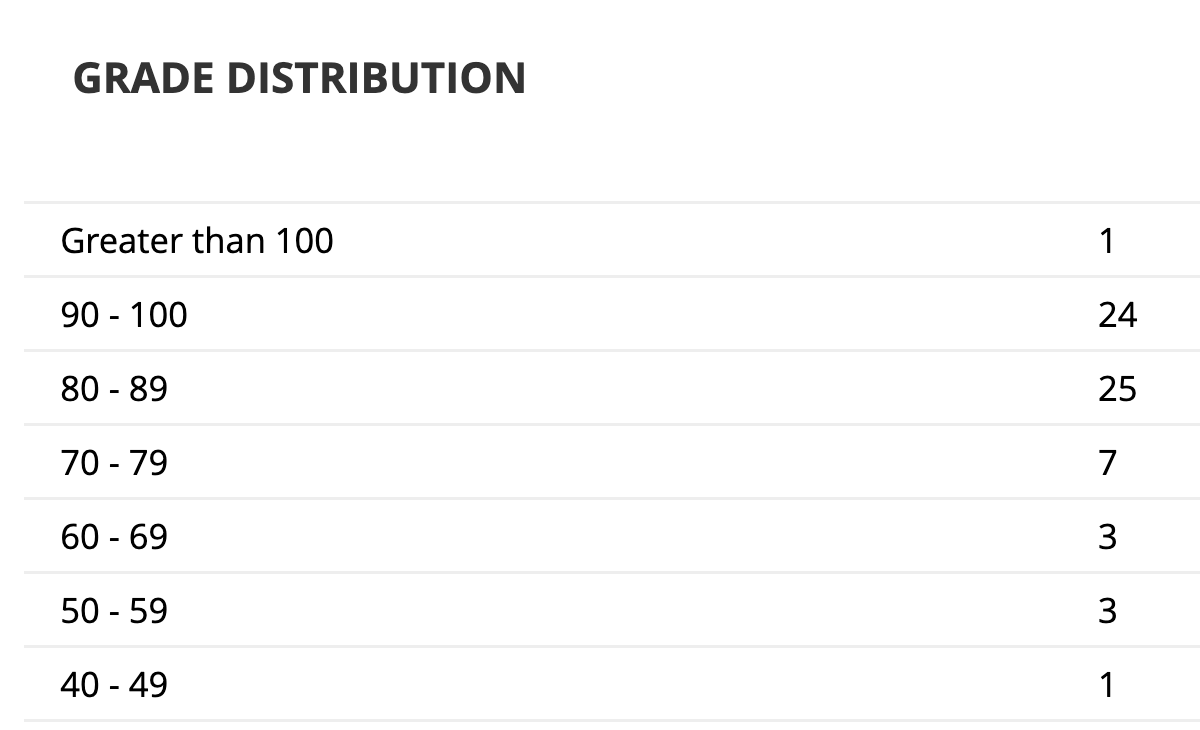
The end test of a course is how well students have learned after a full semester. There were a total of 869 points across all assignments and exams. The final score is the ratio of student’s points over this total number. Here is the distribution:
50 students scored 80% and above, and all but 7 students were 70% or higher. I had the most fun problem which was deciding between a B+ and an A- for the 8 students who were between 88.94% and 90.2%. This is much better than what I expected from such a difficult course. I remember telling my colleagues who were duly impressed by my students. I am still immensely proud of what they have done.
Parting Thoughts
“One might as well say he has sold when no one has bought as to say he has taught when no one has learned.” — John Dewey in Logic The Theory of Inquiry
The course has its problems that can and should be improved. One that’s difficult to fix is that students learned RISC-V and then read the CS:APP textbook which uses x86. Right now, they have to map the book examples to RISC-V themselves. The evaluation score is 3.53 for overall instructor and 3.4 for the course, lower than my typical scores (here and here). Seven respondents gave the highest rating, and two the lowest. I appreciate students wrote in the evaluation and in public (here). What’s online is anecdotally true but not complete or comprehensive. My blog is partly to tell the part of the extensive learning that computer science students have accomplished in one of their courses in their four-year journey at Rochester.
Acknowledgements: including but not limited to CS staff Ian Ward and Dave Costello; my TAs Yifan, Boyang, Leo, Jacob, Kestor, Yekai, Zack, and Zachary; and my colleague John Criswell (for suggesting the xargs project).
CSC 253/453 Collaborative Programming and Software Design
Fall 2023 Student Evaluation
Anonymous inputs were collected by the university before the final exam. 9 out of 25 students (36%) submitted the evaluation.
The overall Instructor Rating is 4.89, same as the overall Course Rating.
All nine students gave highest or next highest score to the questions:
Teaching Skills
Rapport with Students
Academic Honesty
Value of the Course
Some of the comments include:
I particularly relished the final big project, which was both challenging and immensely rewarding. Working collaboratively with my team was a highlight, fostering a sense of friendship and shared purpose that made the learning process especially enjoyable. However, I do wish we had more time allocated for this final project. The complexity and scale of the project made it engaging, and having additional time would have allowed us to delve deeper into the coding challenges and explore more creative solutions as a team.
hard course
This course has a strong emphasis on collaboration, which is very helpful for my future work. Project is a little bit hard and it takes a lot of time.
 Rochester Programming Systems Reseach