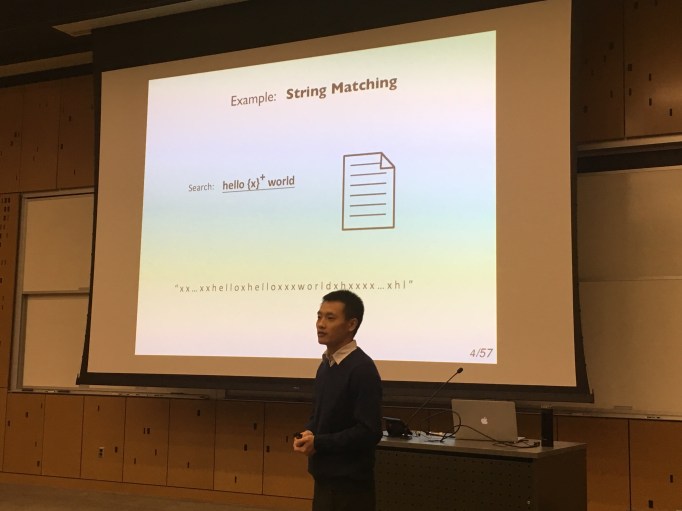
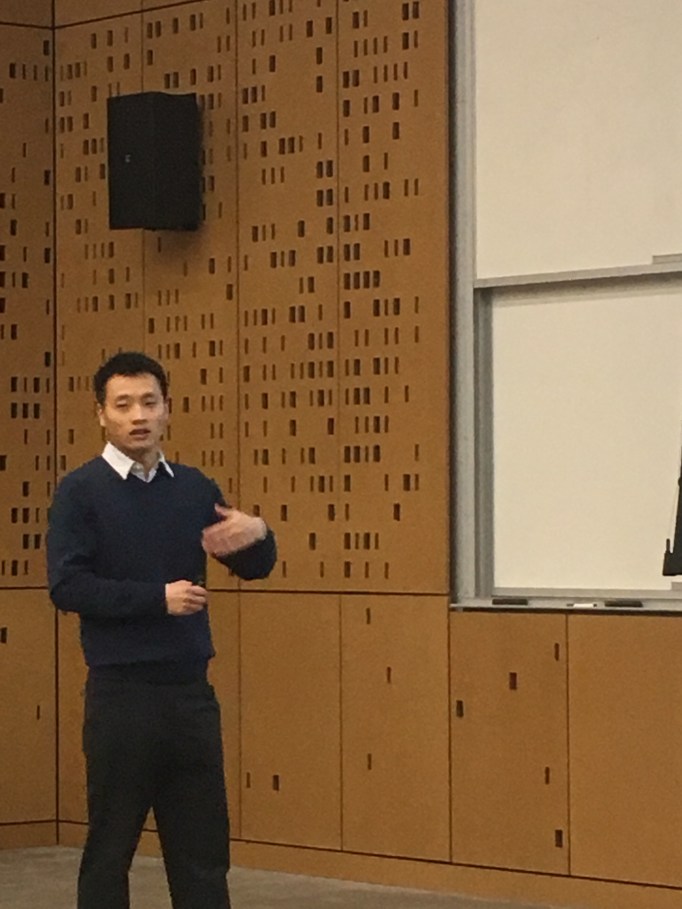
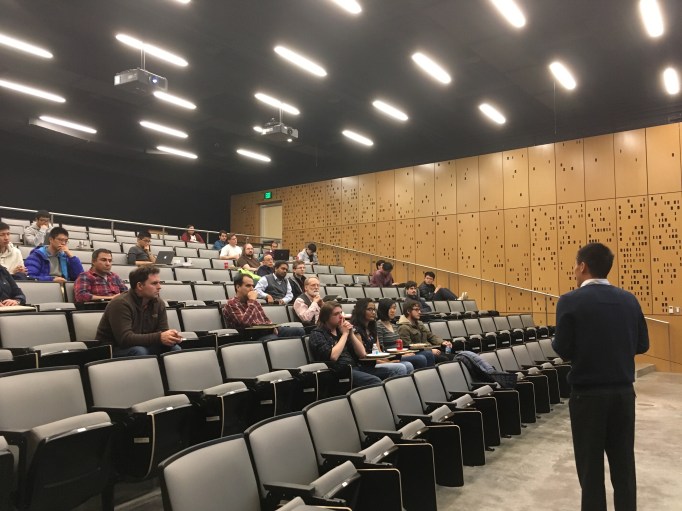
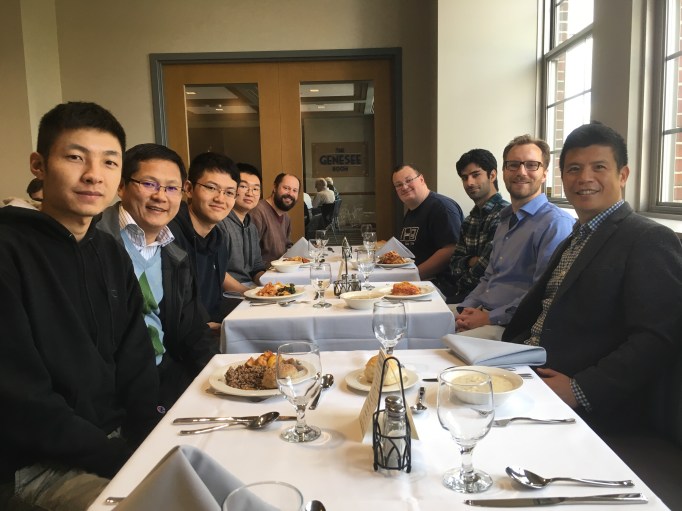
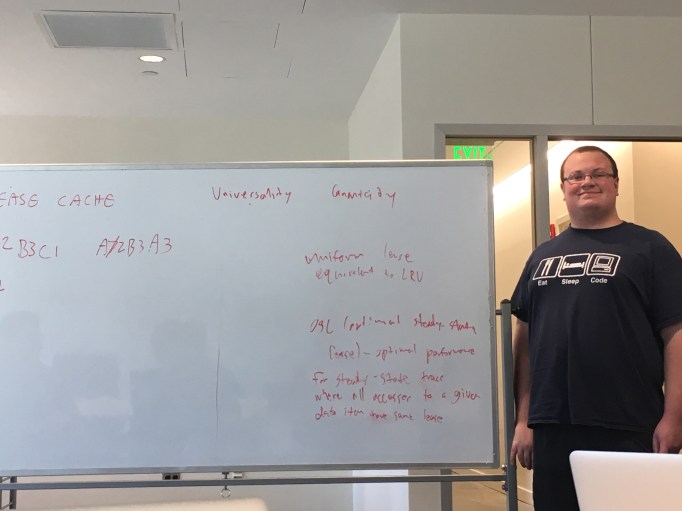
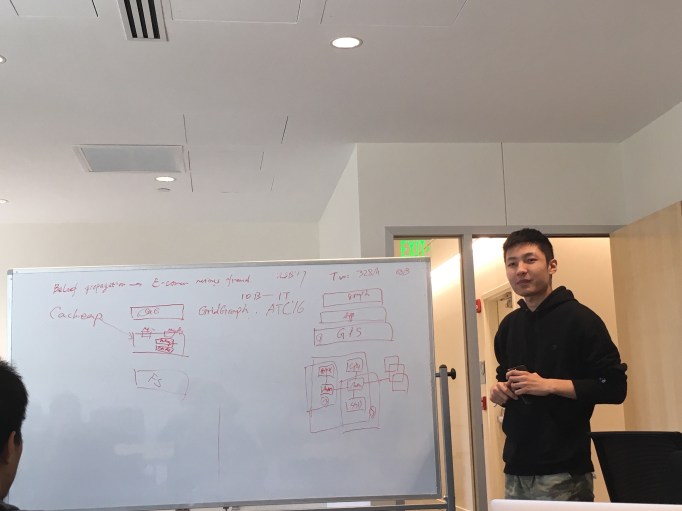
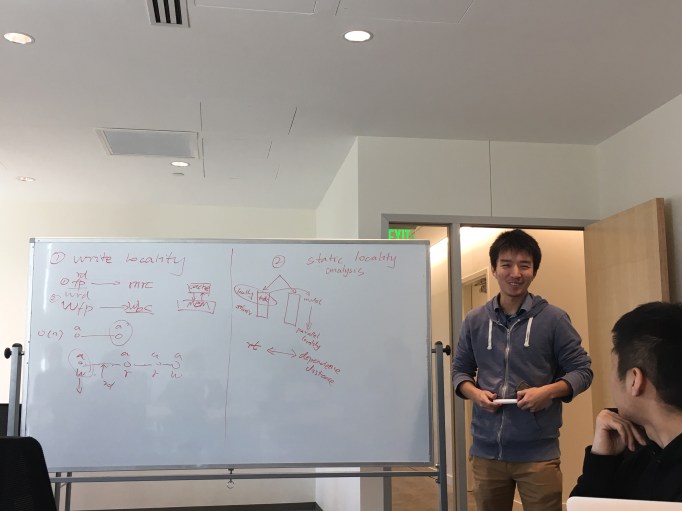
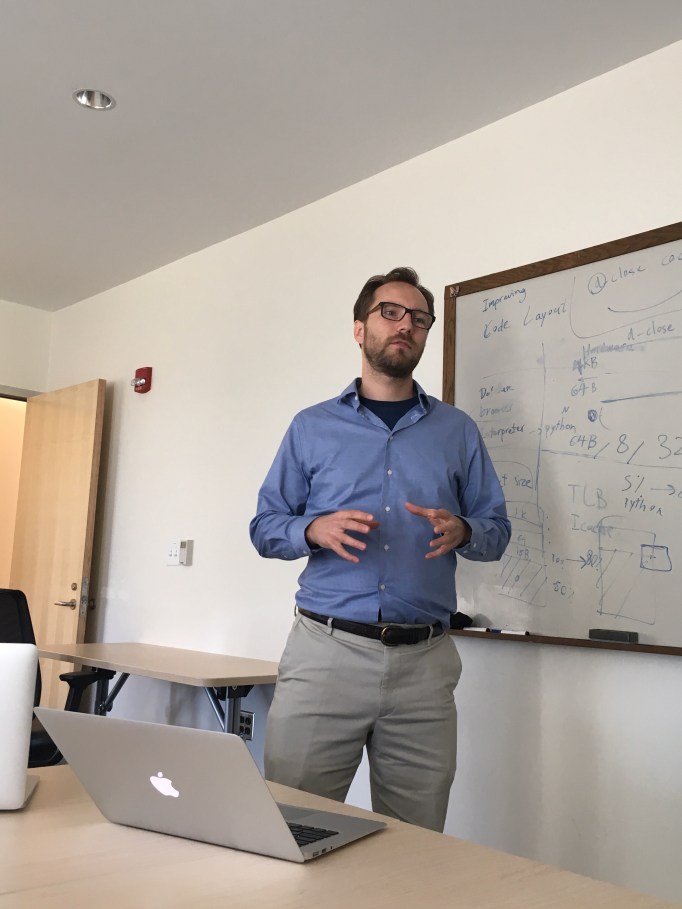
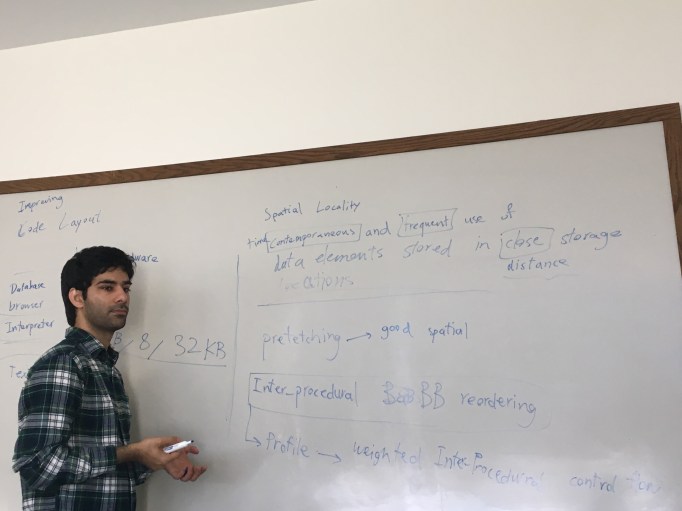
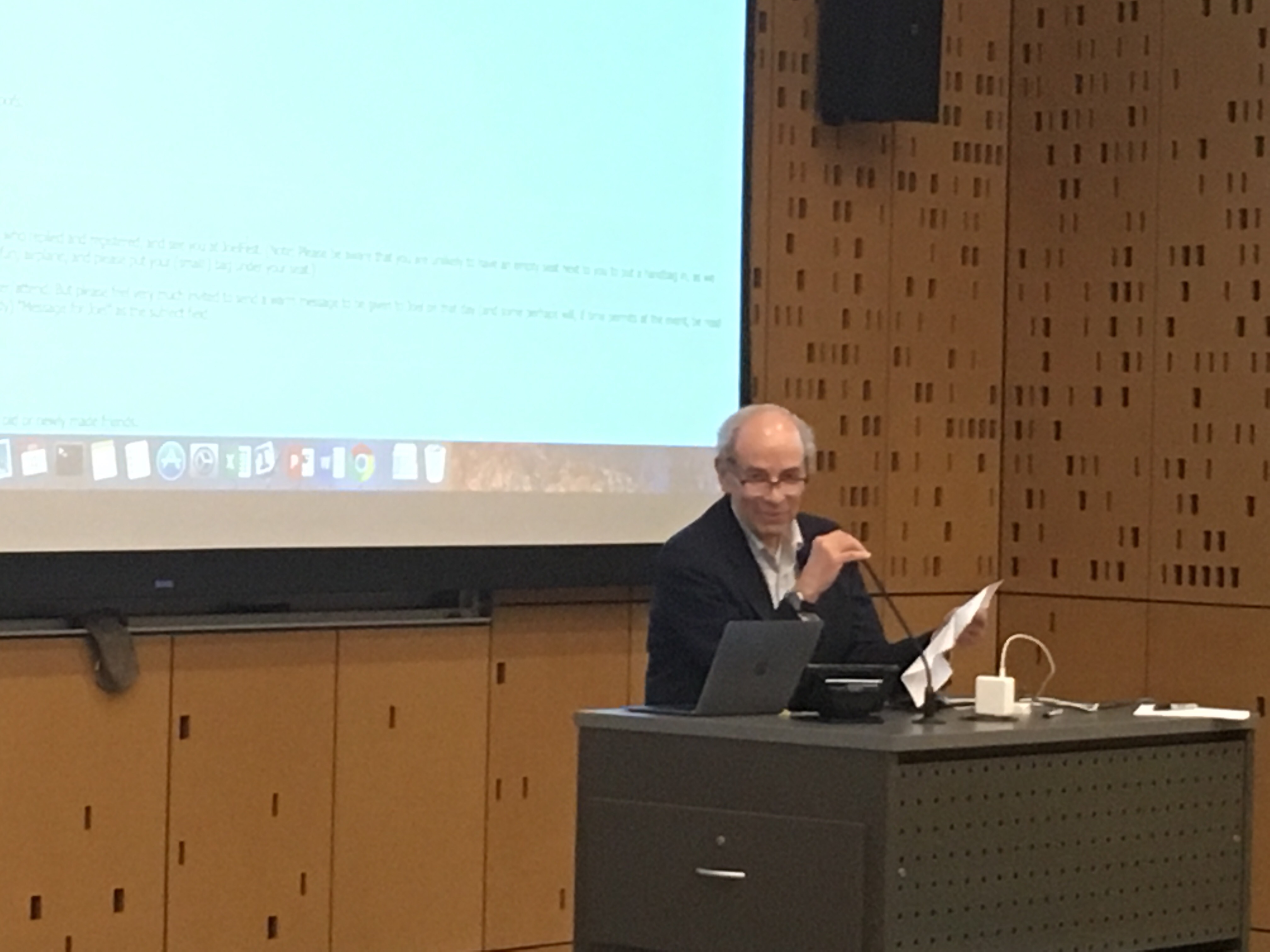
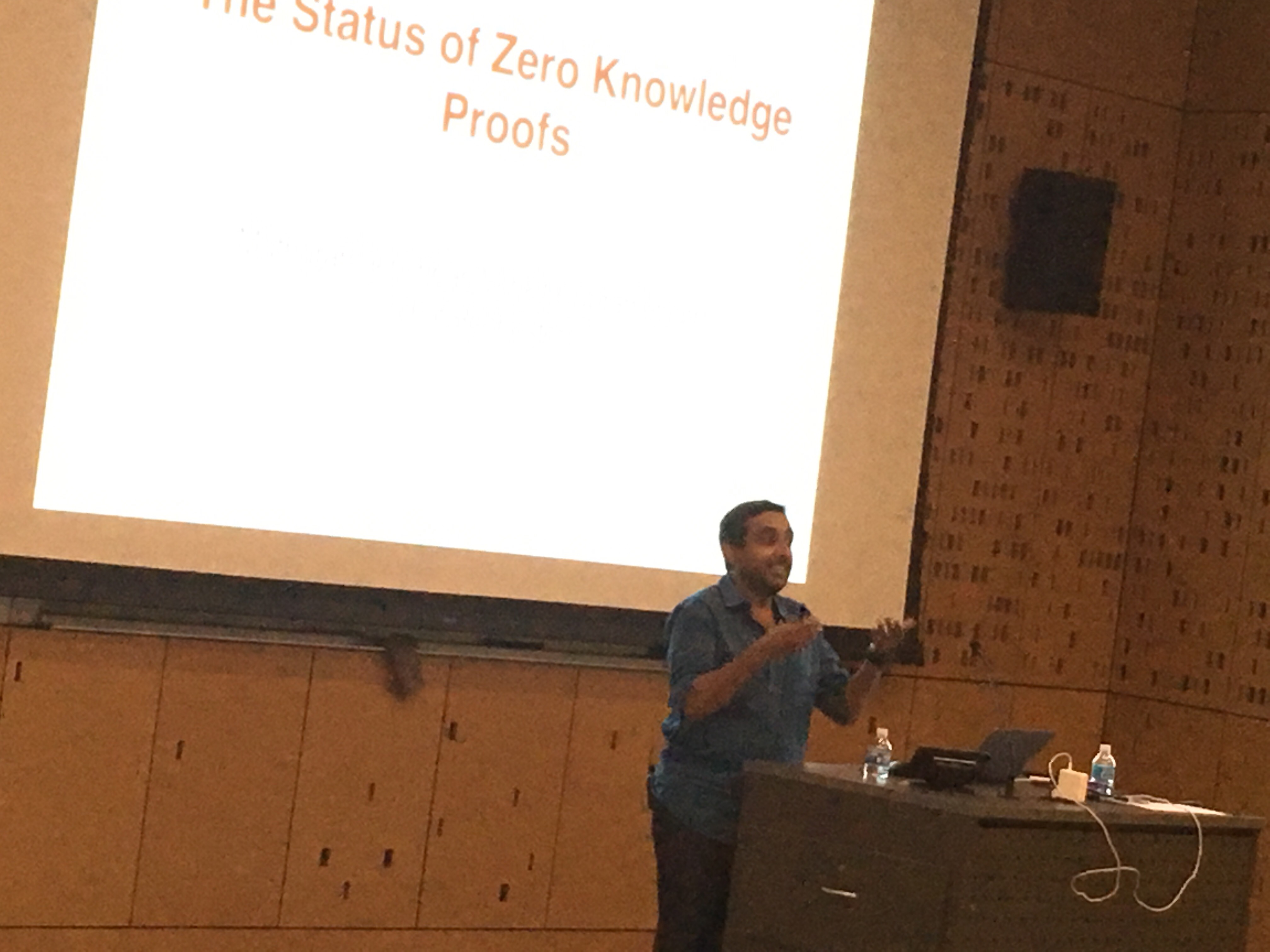
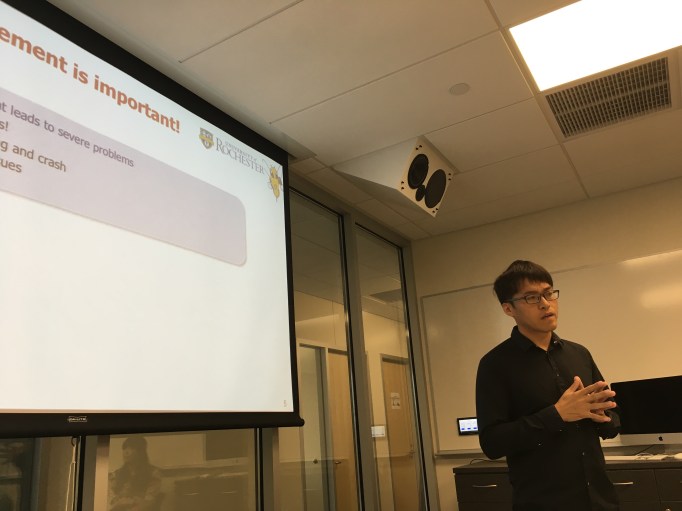
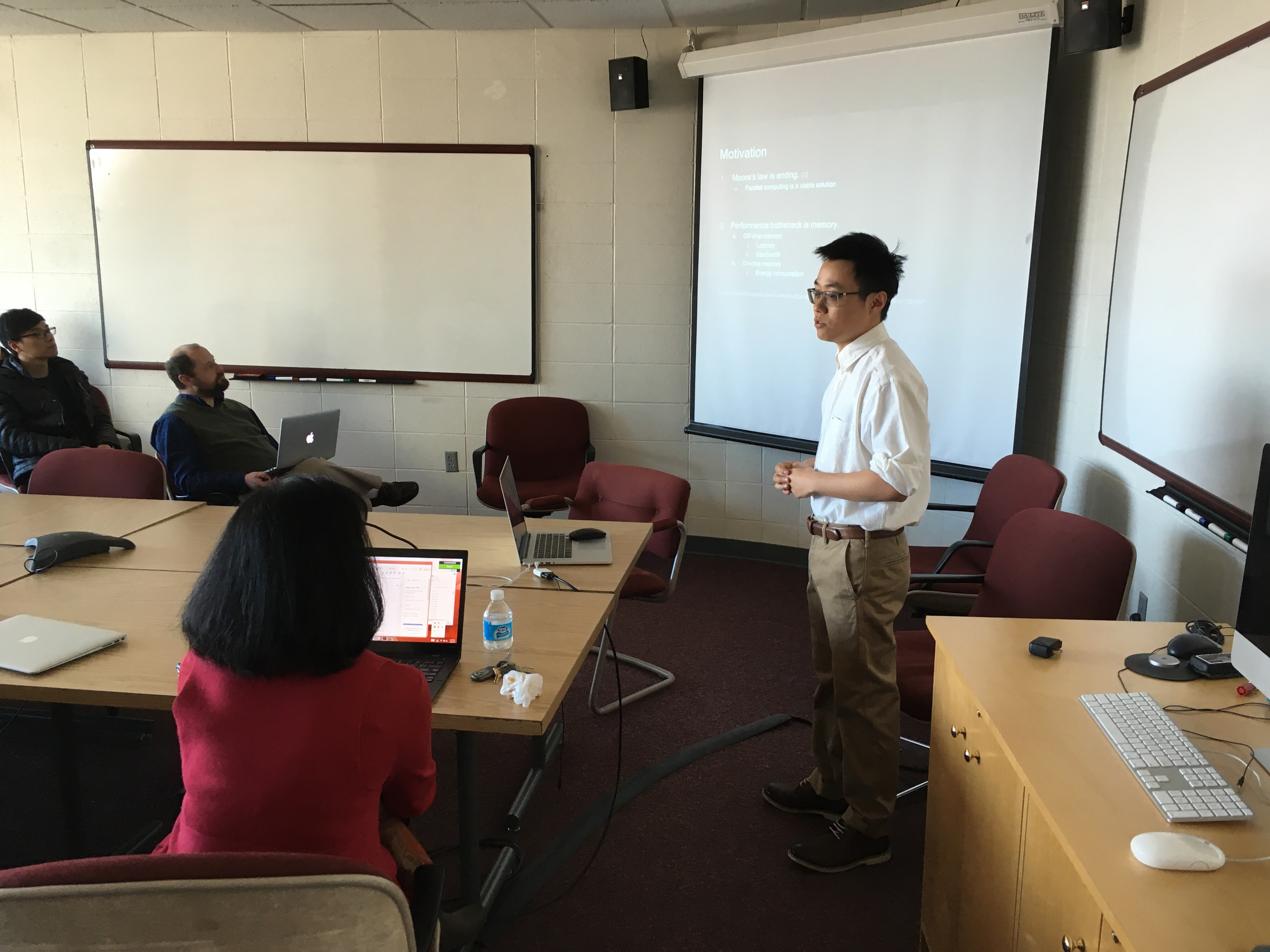
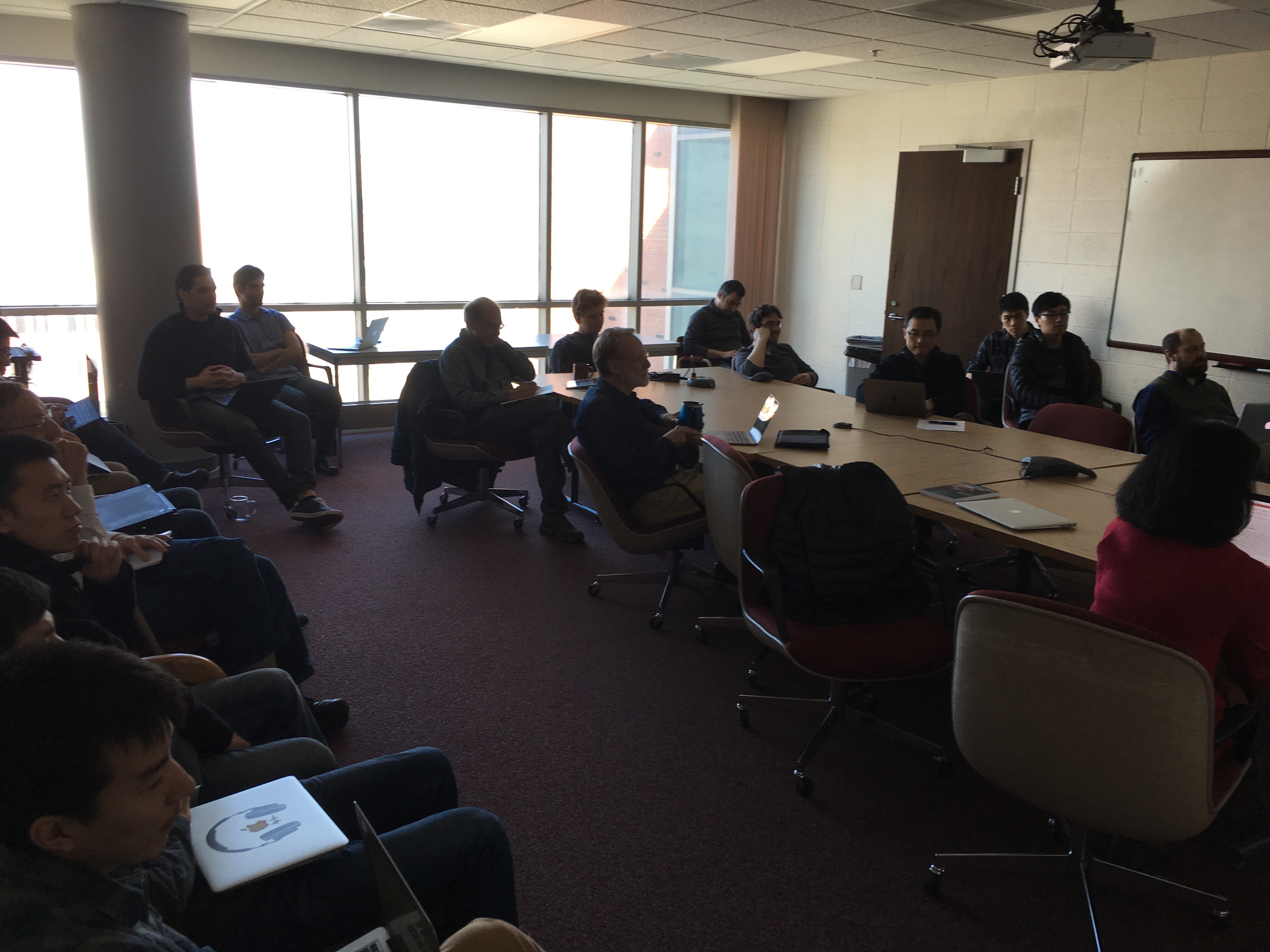
The Computer Science Department Seminar on Monday Nov. 27, 2017 was Automata-Centric Parallelization for Scalable and Parallel Data Processing, given by Prof. Zhijia Zhao of University of Californa, Riverside.


The Computer Science Department Seminar on Monday Nov. 27, 2017 was Automata-Centric Parallelization for Scalable and Parallel Data Processing, given by Prof. Zhijia Zhao of University of Californa, Riverside.


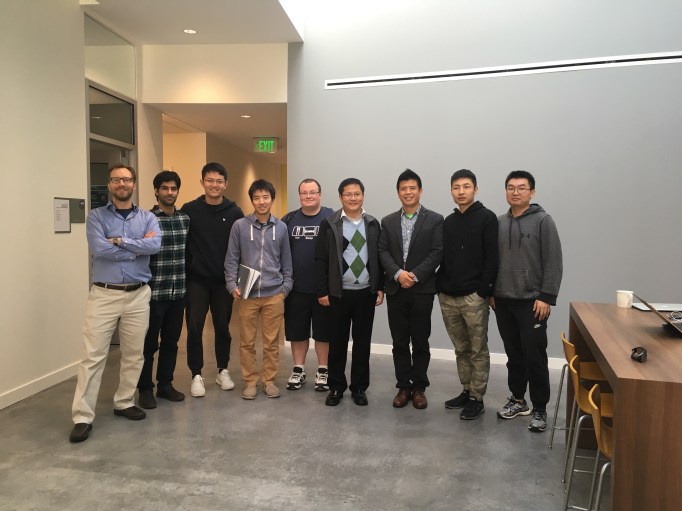
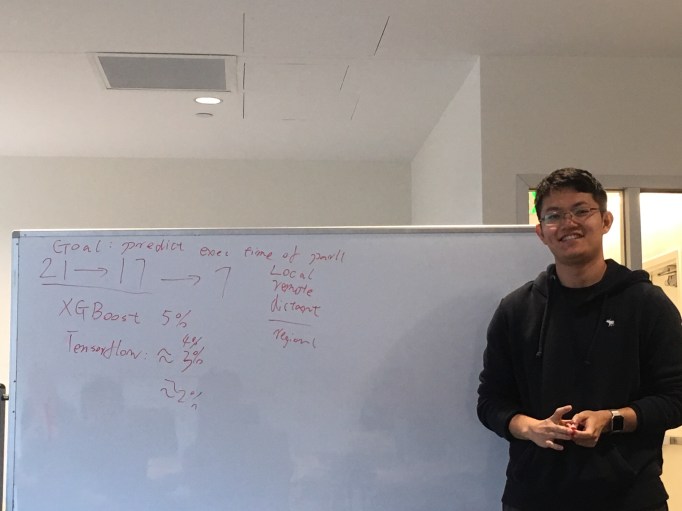
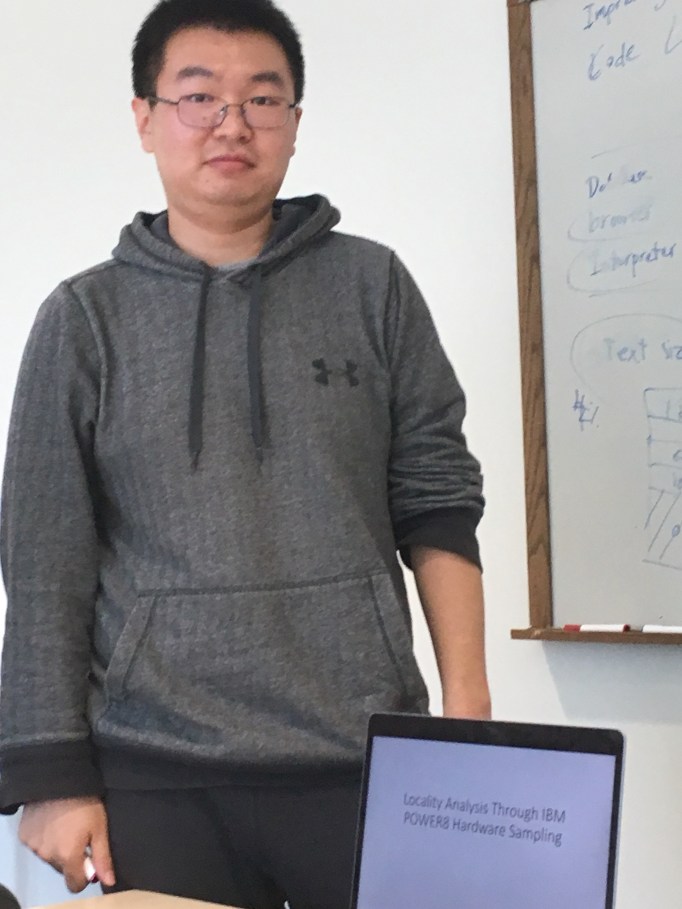
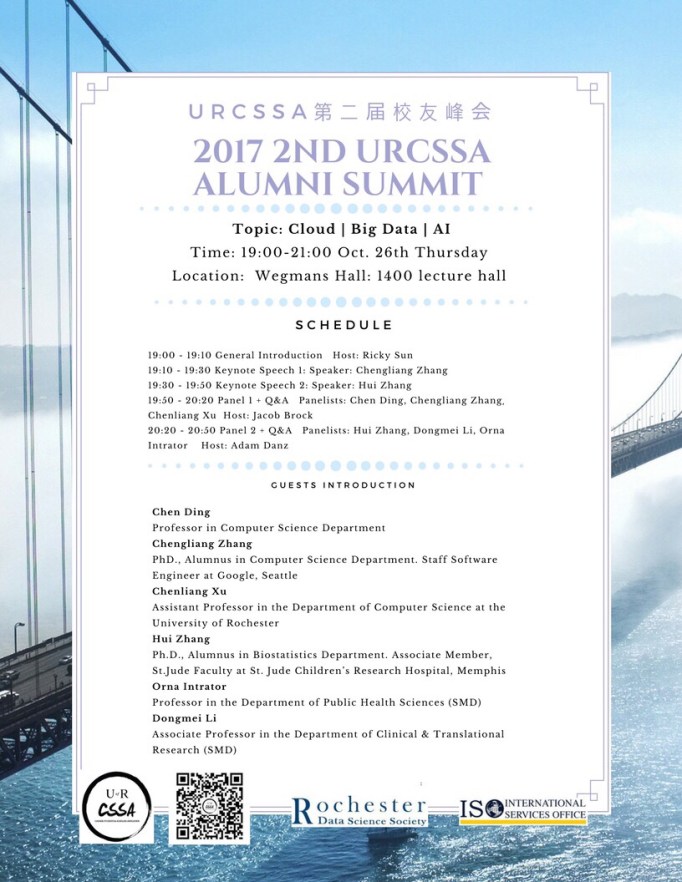
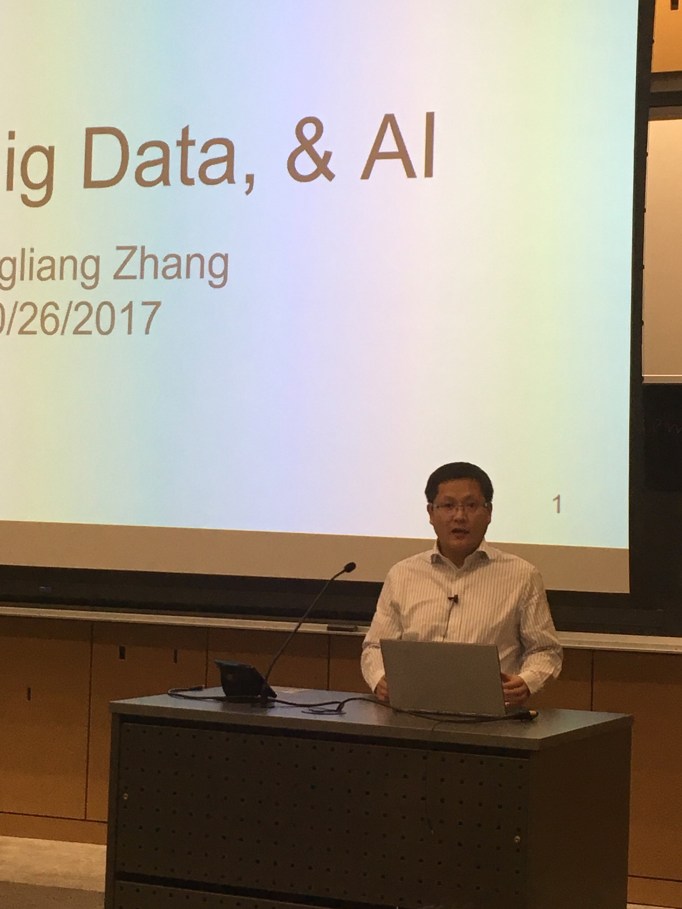
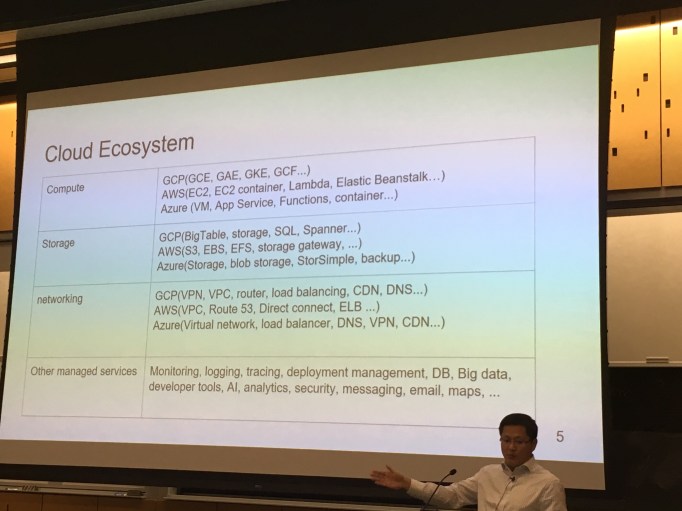
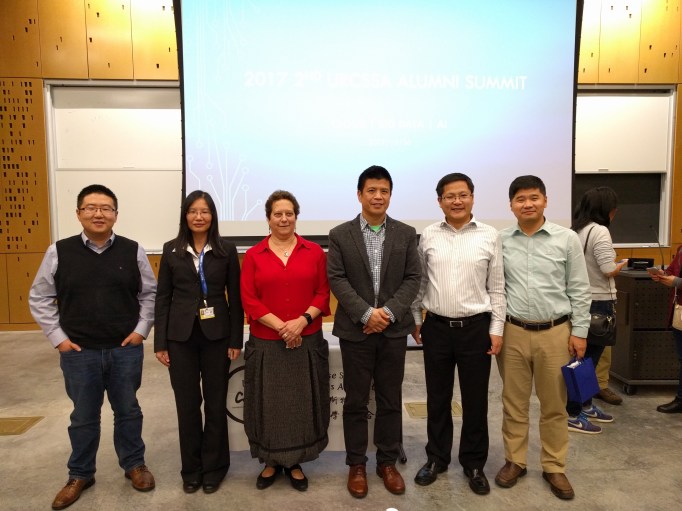
On Oct. 26, Dr. Chengliang Zhang, former graduate and now Staff Software Engineer at Google Seattle, was invited by Chinese Student and Scholar Association (URCSSA) to speak at the second Alumni Summit titled Cloud | Big Data | AI. The compiler group held a separate mini-symposium to present our research and had lunch with our esteemed graduate.


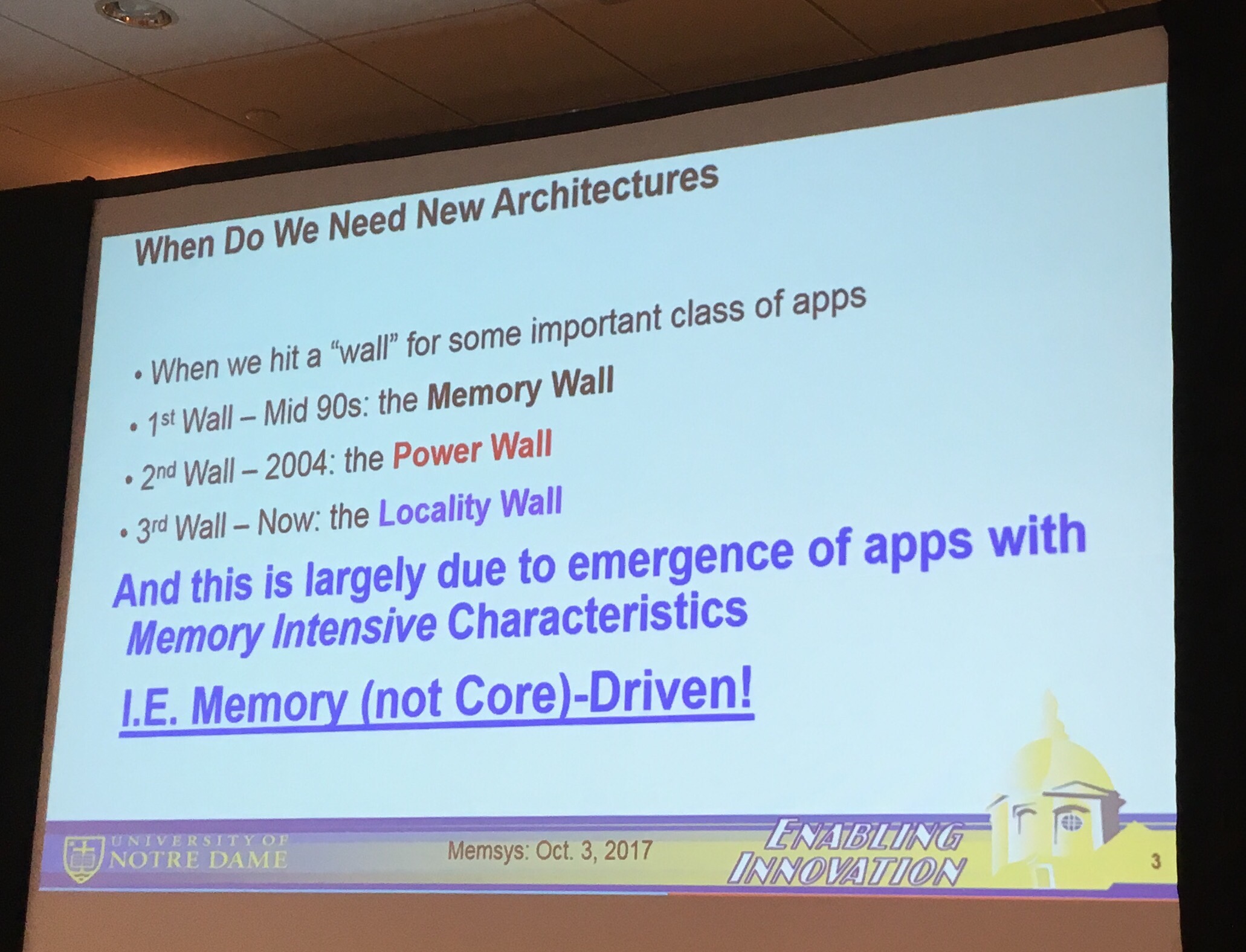
Three Walls by the Monday’s keynote speaker Peter Kogge, University of Notre Dame
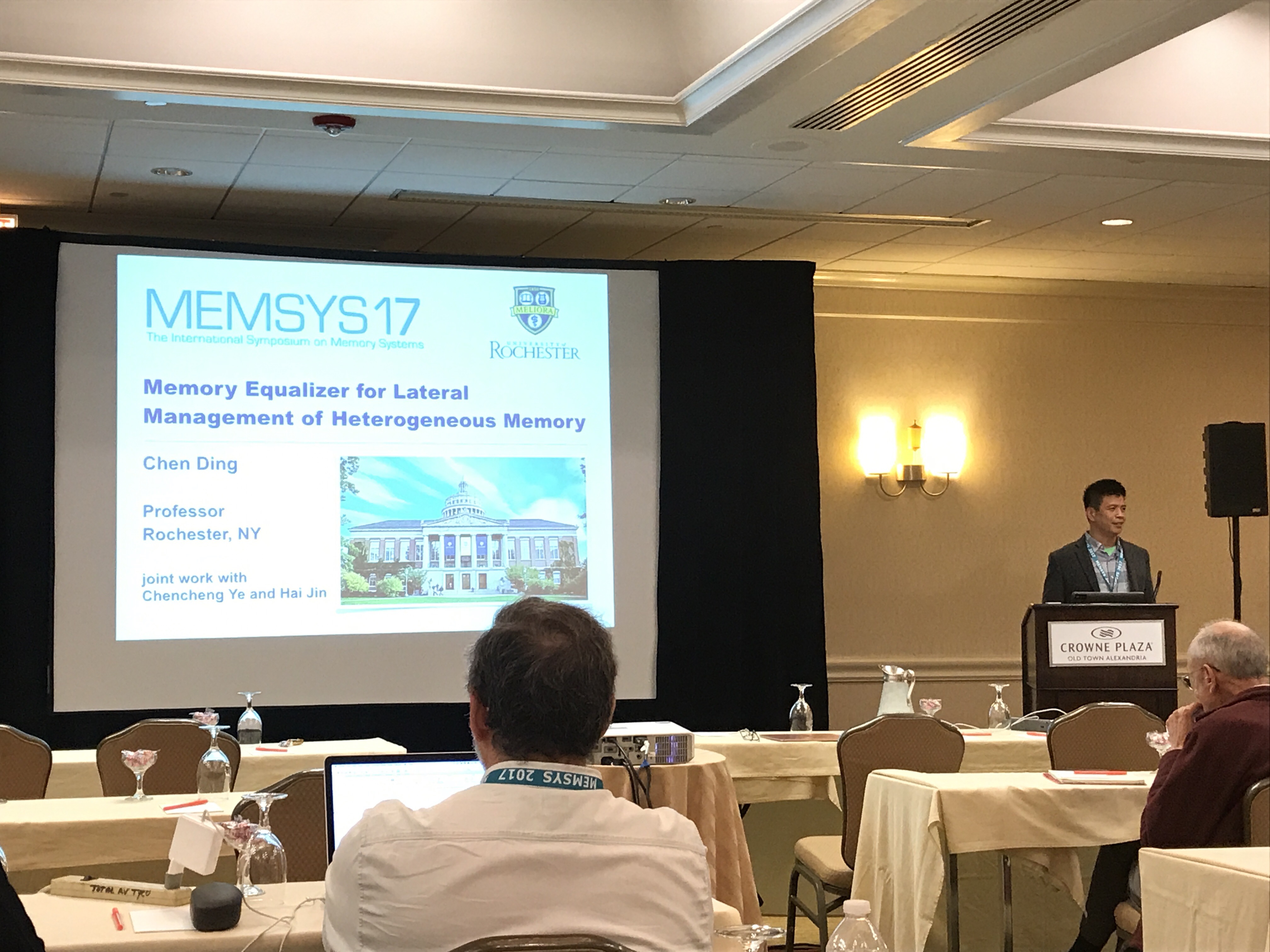
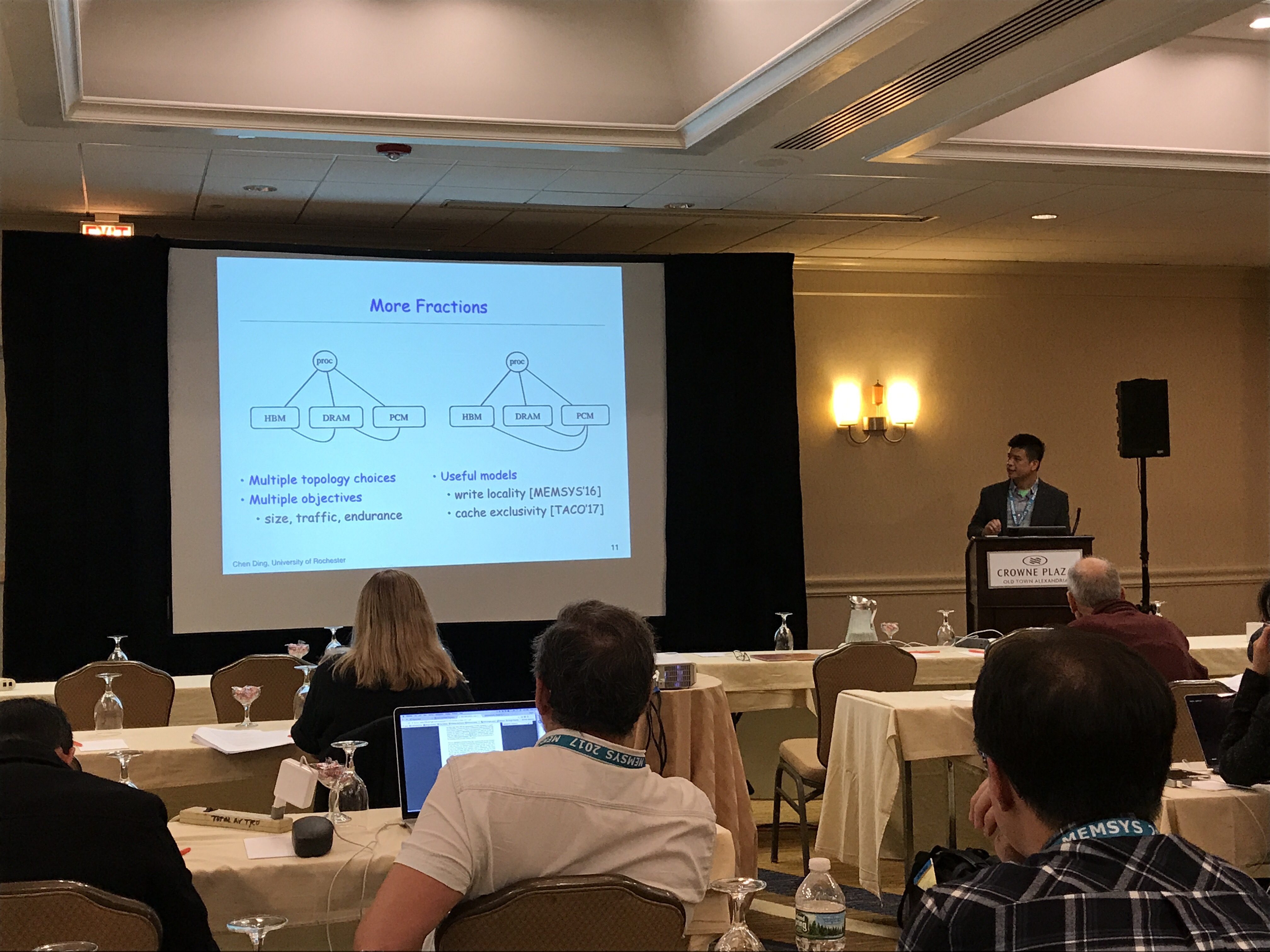
Memory Equalizer for Lateral Management of Heterogeneous Memory
Chen Ding (University of Rochester), Chencheng Ye (Huazhong University of Science and Technology), Hai Jin (Huazhong University of Science and Technology)
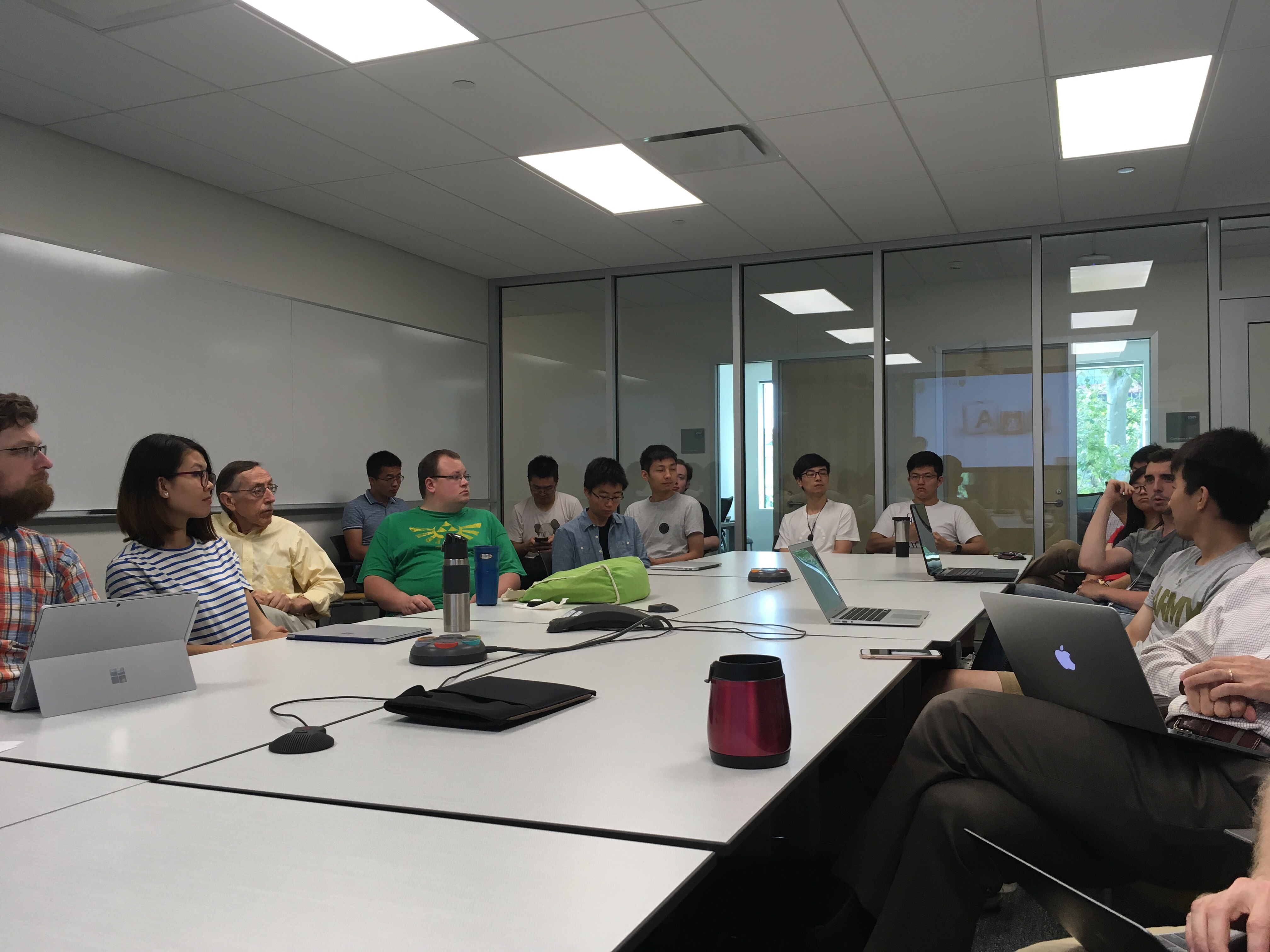
Spirited Discussion
Memory Systems Problems and Solutions
• Chen Ding, University of Rochester
• David Donofrio, Berkeley Labs
• Scott Lloyd, LLNL
• Dave Resnick, Sandia
• Uzi Vishkin, University of Maryland
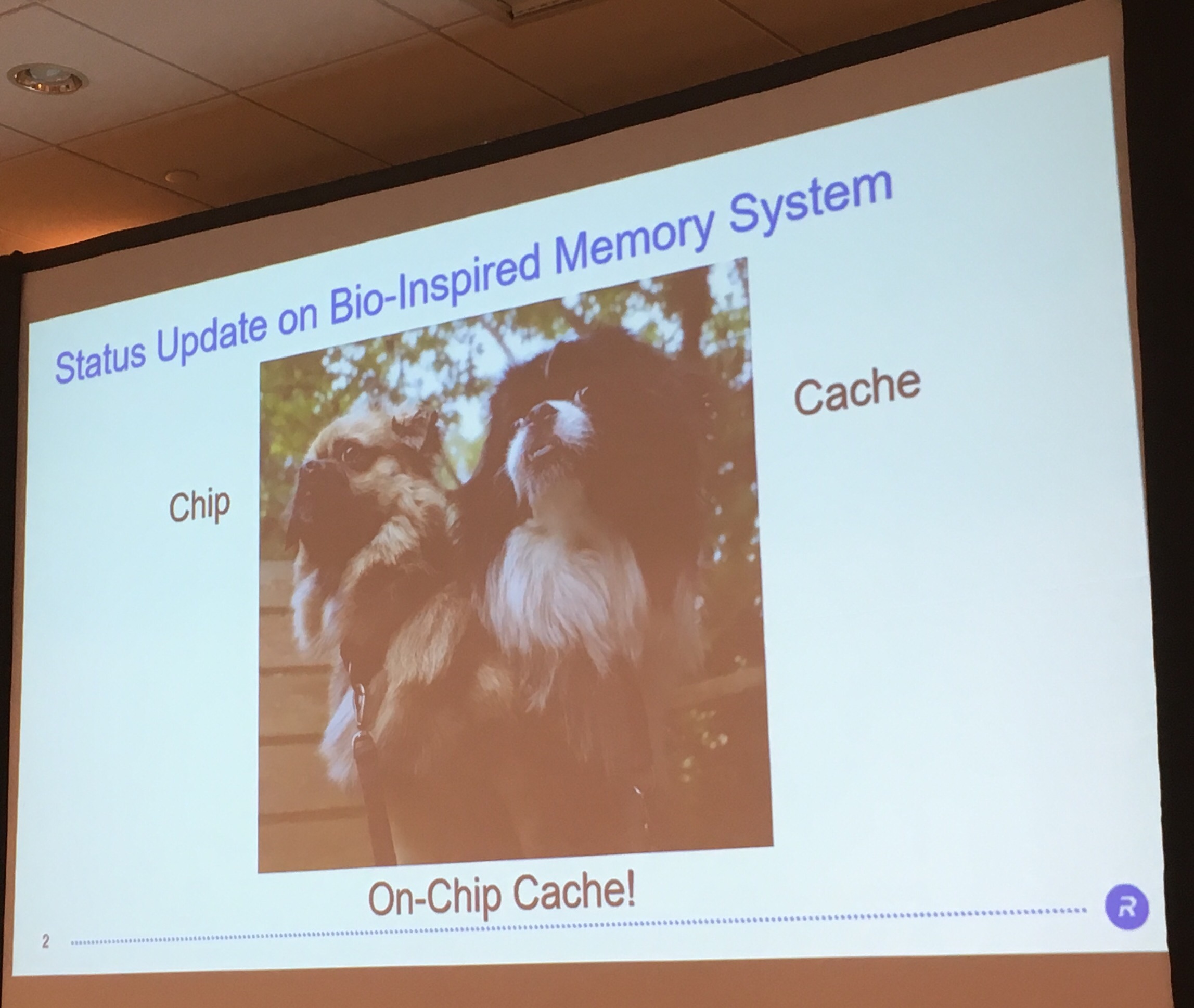
Sally McKee: on Chip Cache
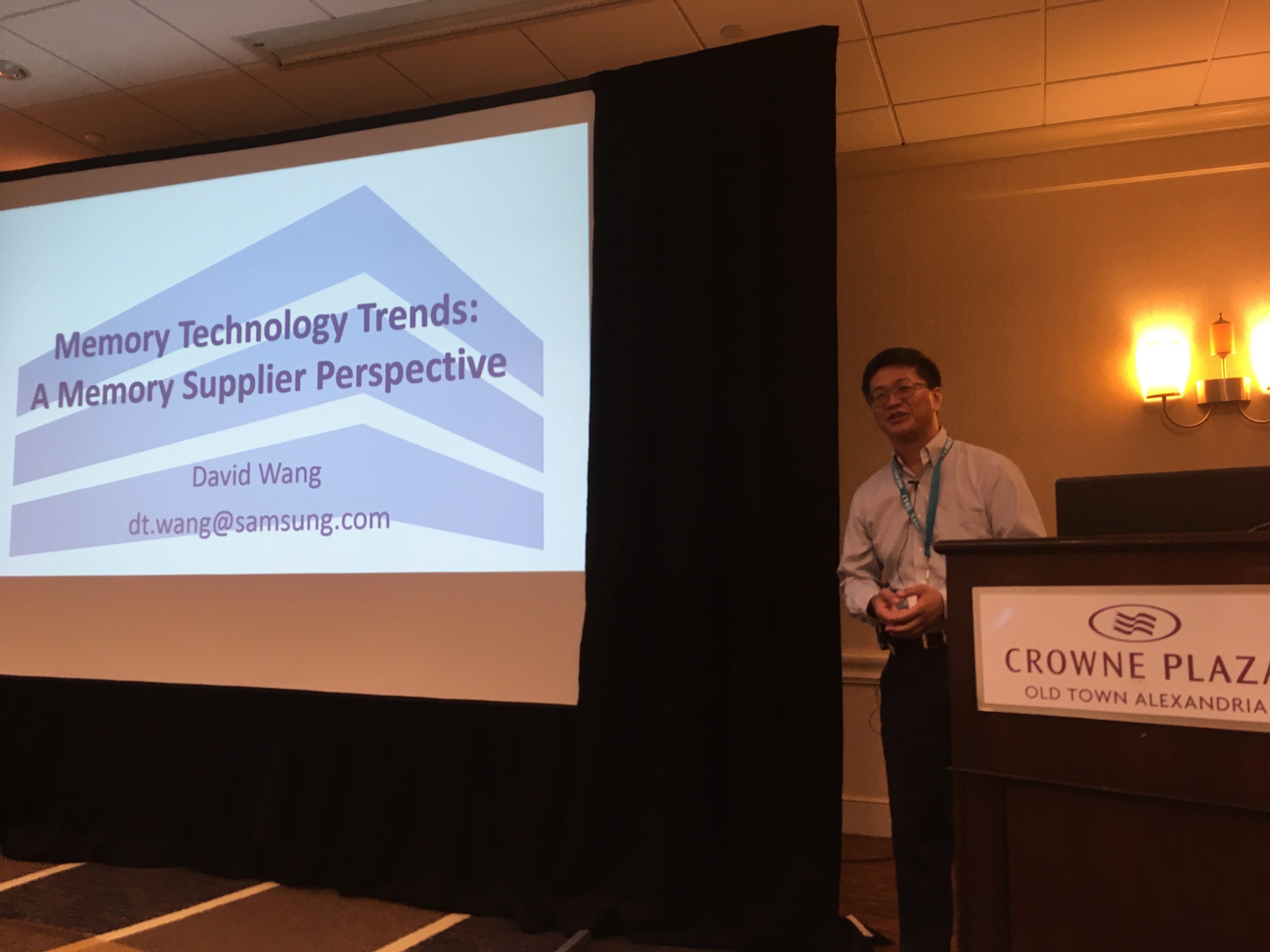
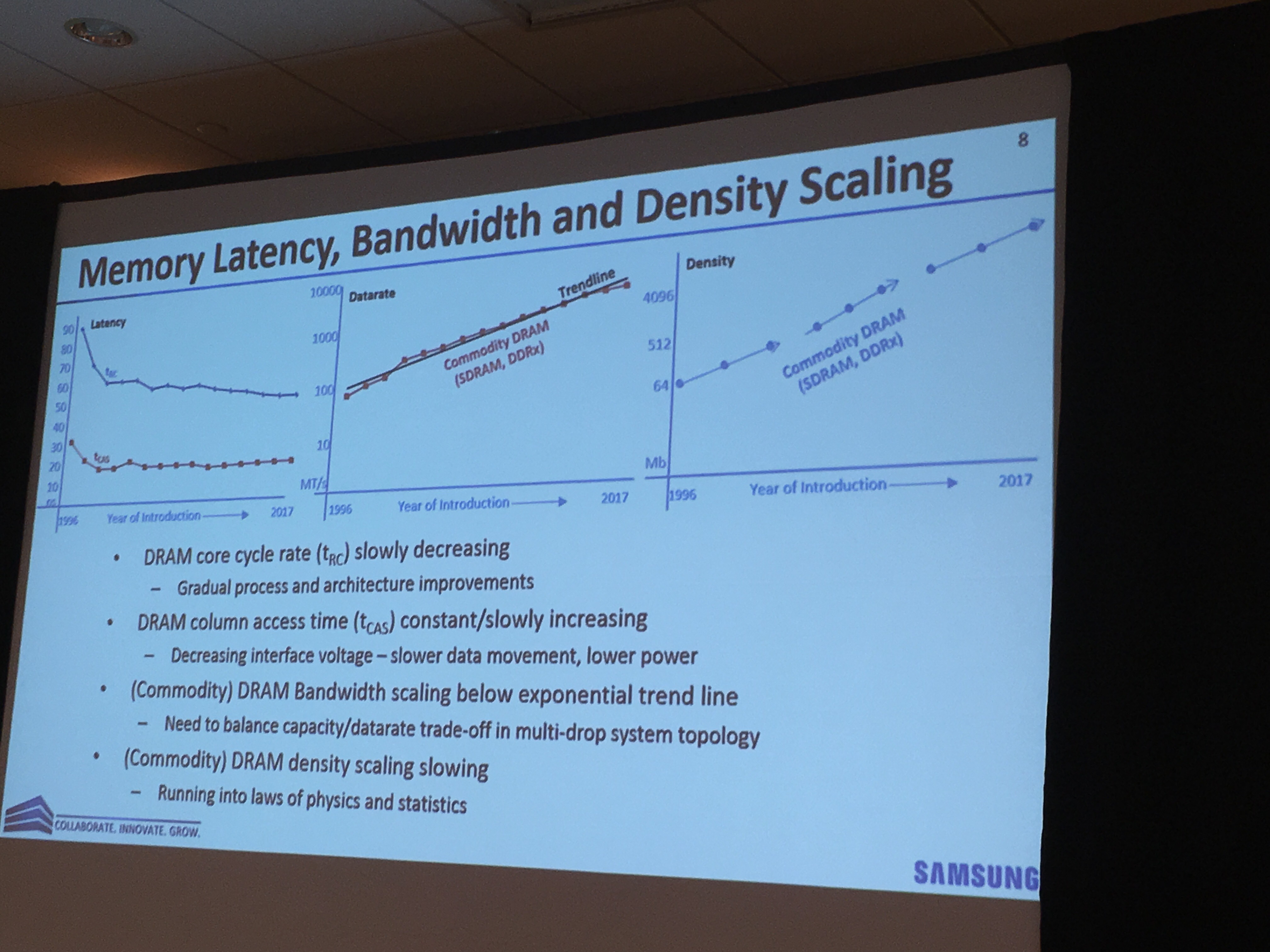
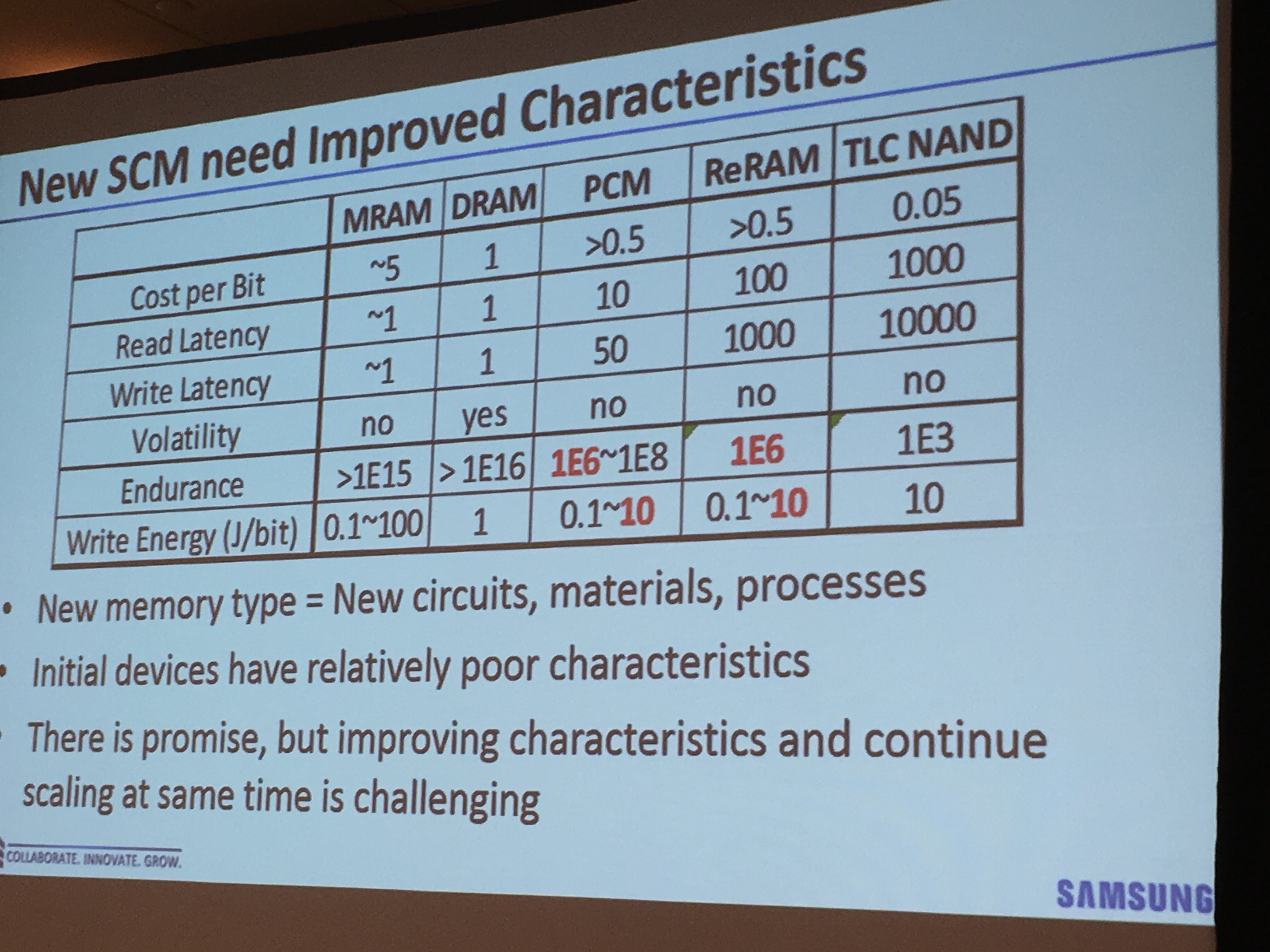
David Wang keynote
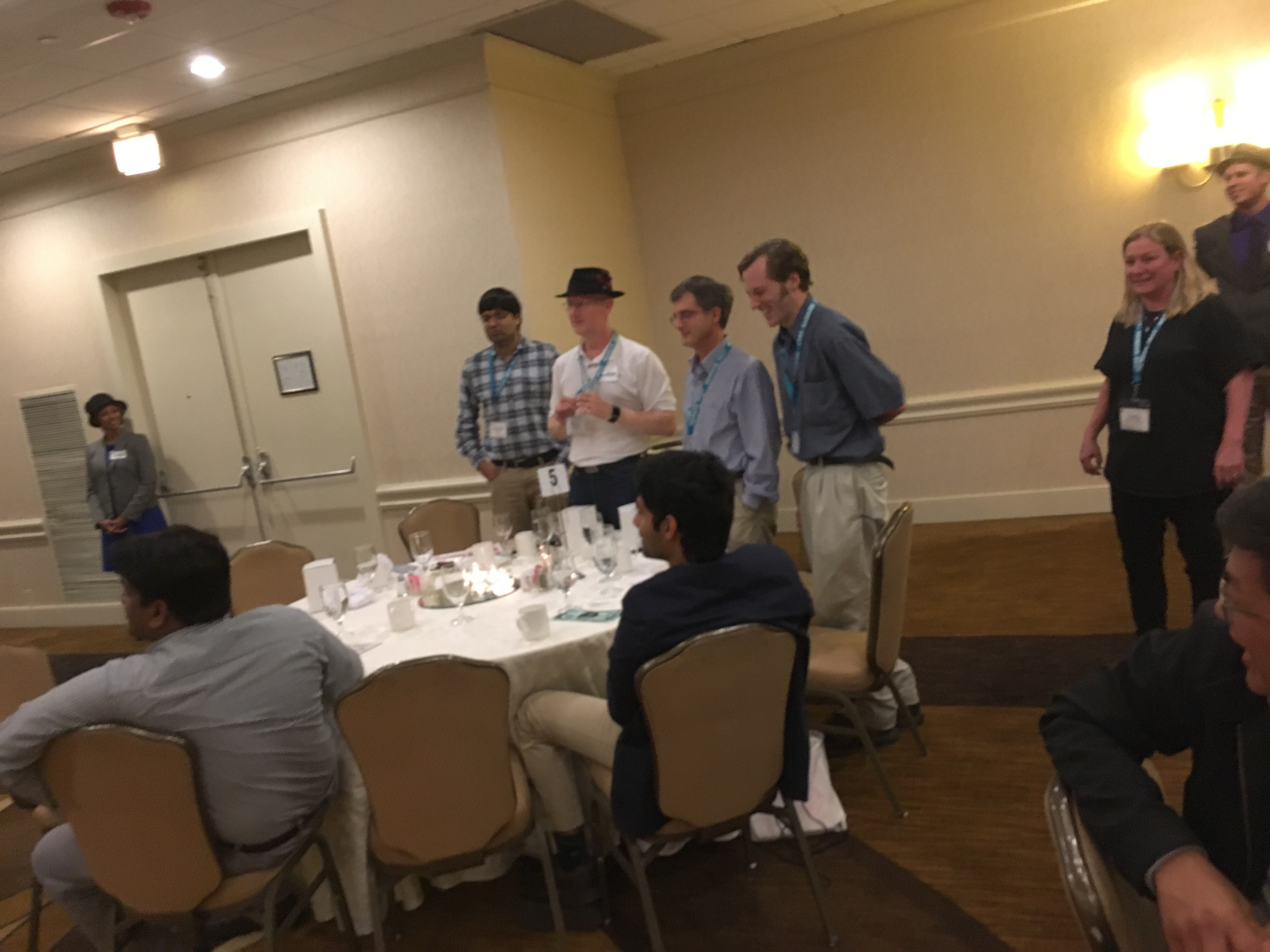
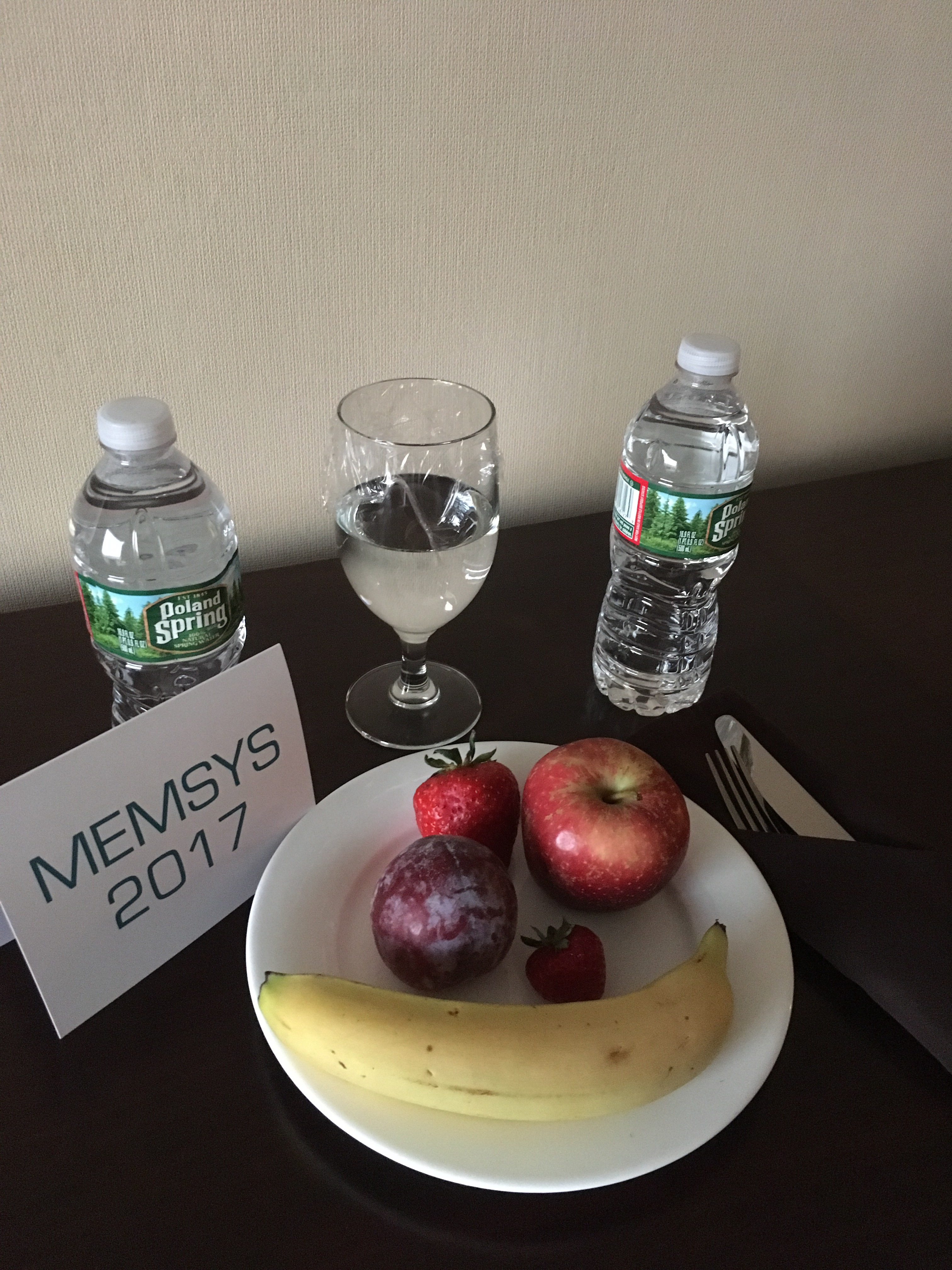
Hotel accommodation and conference dinner (and investigation … of murder)

From Lane: “On Labor Day (Sept. 4), URCS will host a day of talks by wonderful speakers … in honor of our wonderful colleague Joel I. Seiferas’s retirement.”
JS: “Good morning and welcome. As the ‘Joel’ of ‘JoelFest,’ I have asked to say a (very) few words of introduction.
I can’t take credit for today’s program of distinguished speakers (or the presence of other notable colleagues), but I am happy that my recent retirement can be the excuse for it. I hope everyone enjoys and is stimulated by what you hear today.
…
Thanks for today are also due to all of the following: …
Anyway, the U. of R. is clearly a great place to retire from.
More significantly (but briefly), Rochester also has been a wonderful place to work since I came here in 1979:

Prerequisites: CSC 252 and CSC 254 are required for CSC 453 and recommended for CSC 253. Familiarity with a dynamic programming language such as Python is required for CSC 253.
Crosslisted: TCS 453 (same requirement as CSC 253)
This course studies dynamically-typed programming languages and modular software development. Topics include principles and practice of modular design, functional and object-oriented programming techniques, software engineering concepts, software correctness and reliability, programming tools, and design examples. Ruby is used as the main instruction language. The lessons complement those in traditional compilers and programming languages courses, which focus mainly on statically-typed languages and individual algorithms rather than system design. A significant portion of the assignment is a group project.
Teaching Staff and office hours: Prof. Chen Ding, Fridays 11am to 12pm in Wegmans Hall 3407, x51373. John Jacob, 1pm to 2, Tuesdays, in the corner next to Wegmans Hall 3409. Zhizhou Zhang, 3:30pm to 4:30, Thursdays, Wegmans Hall 3407, x51373.
Preparation (before first class):
“No Silver Bullet — Essence and Accidents of Software Engineering” is a classic paper on software engineering written by Turing Award winner Fred Brooks in 1986. Read the paper (available here if accessed inside the UR network) especially pages 3 to 5 on the “essential difficulties” of software development.
“A former member of the SD10 Panel on Computing in Support of Battle Management explains why he believes the ‘star wars’ effort will not achieve its stated goals.” Read the paper (available here if accessed inside the UR network) pages 2 to 4 the section titled “Why software is unreliable.” Which of the “essential difficulties” was Parnas discussing?
More background of this debate, detailed rationales and an illuminating discussion of the ethical issues can be found in another article of Parnas: “SDI: A Violation of Professional Responsibility”. The article does not seem to have a free version online, but you can read it by borrowing the book “Software Fundamentals” (included as Chapter 27) from the textbook reserve for CSC 253/453 at the Carlson Library. The lease is two hours.
Further material will be distributed through the Blackboard web site for students who have registered. Contact the instructor if you have problem accessing the site.
Textbooks (online access at learn.rochester.edu > CSC 253 > Reserves > Materials on Reserve in the Library):
| Software fundamentals : collected papers by David L. Parnas Author: Parnas, David Lorge. Imprint: Boston : Addison-Wesley, 2001. On Reserve at: Carlson Library Reserve Desk 2nd Floor Call Number: QA76.754 .P365 2001 |
Programming Languages: Application and Interpretation (http://cs.brown.edu/~sk/Publications/Books/ProgLangs/2007-04-26/)
Copyright © 2003-07, Shriram Krishnamurthi
(Also see Prof. Findler’s course EECS 321 at https://www.eecs.northwestern.edu/~robby/courses/)
Object-oriented Software Engineering
Author: Schach, Stephen R.
Imprint: New York : McGraw-Hill, c2008.
Available at school book store. On Reserve at: Carlson Library Reserve Desk 2nd Floor
| Design patterns in Ruby [electronic resource] Author: Olsen, Russ. Imprint: Upper Saddle River, NJ : Addison-Wesley, c2008. On Reserve at: Internet |
Other Materials
| Ruby under a microscope [electronic resource] : an illustrated guide to Ruby internals Author: Shaughnessy, Pat. Imprint: San Francisco : No Starch Press, [2014] Available at school book store. Also on Reserve at: Internet |
| Fundamentals of software engineering Author: Ghezzi, Carlo. Imprint: Upper Saddle River, N.J. : Prentice Hall, c2003. On Reserve at: Carlson Library Reserve Desk 2nd Floor Call Number: QA76.758 .G47 2003 |
PROGRAMMING LANGUAGE PRAGMATICS, 3rd ed
Author: Scott, Michael L.
On Reserve at: Carlson Library Reserve Desk 2nd Floor
Call Number: CRL PersCpy
Topics:
See schedule
At Rochester we have studied the Dan-Towsley model multiple times. The description in their paper takes some effort to understand. Here we put down additional explanation for anyone who is interested in this model. The formulas included here are screen copies from the original paper.
In this problem, we have a collection of D fixed size items that share an LRU cache that can store B items. The D items are divided into k partitions. Each partition has D_k items and is accessed with the probability alpha_k. The access is assumed to be uniformly random within each partition. This corresponds to the Independence Reference Model (IRM) of King in 1971.
The LRU cache can be viewed as a stack with most recently accessed item at the top and least recently accessed item at the bottom. The cache state is defined by the content of these k positions. In this formulation, the state of each position is the partition id of the data item it stores.
We emphasize the use of partition id, For example for B=3, k=2, and D_1=2, a valid cache state may be (1, 1, 2), with both items of Partition 1 in the cache. This state records only the partition id, not the specific data item.
The following formula gives the set S of all possible cache states:

A valid state is a sequence of B positions with two constraints shown by the formula. First, for each partition k, the number of items in the cache cannot be more than its total number of items, D_k. Second, the total number from all partitions equals to B. Using the example B=3, k=2, and D_1=2 again, (1,1,1) would not be a valid state since it violates the first constraint of S.
King formulated the problem as a Markov Chain. A Markov Chain has a set of states and transition probabilities between the states. A common example is a drunkard’s walk. Let there be a set of bars. When leaving each bar, the drunkard has some probability to go to another bar. As a Markov Chain, each bar is a state. We are interested in computing the likelihood for each state. If we choose a state to compute the likelihood, we call this the target state. We use all the states that may transit into the target state. We call these preceding states. An equation can be constructed to show that the likelihood of the target state from the likelihood of preceding states and the transit probability from them to the target state. For the drunkard, we compute the likelihood that he visits a particular bar, e.g. Starry Night. The Starry Night is the target state. Its likelihood depends on a nearby bar, e.g. Joe Bean, so we can use the likelihood of Joe Bean times the probability that the drunkard would go from Joe Bean to Starry Night.
In the following, the target state x=(x_1, x_2, …, x_B). Its likelihood is computed from all possible preceding states. The first line of the equation shows the transitions due to cache hits, and the next two lines (a product of each other) the transitions due to cache misses.
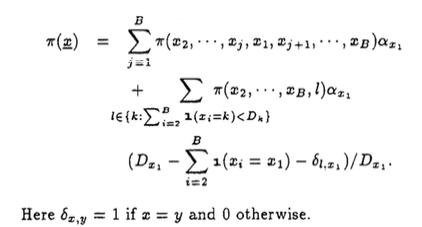
It is understandably non-trivial to solve a Markov Chain problem with this many states and transitions. King gave an exact solution which has a high computational complexity, exponential to D and B.
The Dan-Towsley model is an efficient approximation. It consists of almost entirely the following two equations. Eq. 2 is the key. In Eq. 2, p_k(j) is the probability of a Partition-k item is stored at position j, and r_k(j-1) the probability that if the item at position j-1 moves to j, the probability that this item is from Partition k. The Dan-Towsley model says that the two probabilities are equal.
The equation is recursive, since the two probabilities are used to compute each other. b_k(j) is the occupancy of Partition-k at stack positions up to j. It is computed from p_k(j). This occupancy is used to compute the likelihood that the miss happens for a Partition-k item. Eq. 2 computes r_k(j-1) by a ratio. The denominator is the likelihood of an access at stack position below j-1. This is a miss for B=j-1. The ratio is the likelihood that the miss happens for a Partition-k data item.
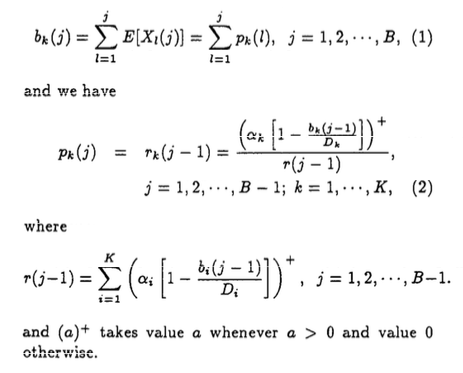
Eq. 2 is easily solvable by iterating starting from j=1 and p_k(1)=alpha_k.
More explanation is needed for Eq. 2. In the text, the paper says that r_k(j-1) is the probability that if the item at position j-1 moves to j, the probability that this item is from Partition k. In the equation, the ratio is likelihood that the miss happens for a Partition-k data item. The two are related in a subtle way — both are required for the occupancy stays the same before and after the miss.
Xiaoming Gu was the first to study and implement the Dan-Towsley model at Rochester. In 2008, he derived the distribution of reuse distance of random access, which corresponds to the solution of IRM for k=1. He then found the Dan-Towsley model and verified it as an efficient and accurate solution for any k.
The Dan-Towsley model is a brilliant solution based on the cache occupancy. Because of the IRM assumptions, the miss ratio can be computed from cache occupancy. The general solution needs to consider locality. The general problem is solved in recent years including the footprint based model developed at Rochester. It is extremely interesting to compare and contrast the occupancy-based model of cache sharing and locality-based models.
Asit Dan, Donald F. Towsley: An Approximate Analysis of the LRU and FIFO Buffer Replacement Schemes. SIGMETRICS 1990: 143-152
King, W. F., “Analysis of Paging Algo- rithms,” In Proc. IFIP Congress, pages 485- 490, Ljublanjana, Yugoslavia, aug 1971.
Gu, Xiaoming, “Reuse Distance Distribution in Random Access“, TR930, Computer Science Dept., U. Rochester, January 2008.
Acknowledgement. The explanation here is partly the result of discussion with Chencheng Ye and Rahman Lavaee. Chencheng’s research is supported by an IBM CAS fellowship, and Rahman by NSF CCF-1629376.

Lecture slides (when used), demonstration programs, and some of the reading material will be distributed through Blackboard. Assignments and projects will be listed here.
With the increasing diversity and complexity of computers and their applications, the development of efficient, reliable software has become increasingly dependent on automatic support from compilers & other program analysis and translation tools. This course covers principal topics in understanding and transforming programs by the compiler and at run time. Specific techniques include data flow and dependence theories and analyses; type checking and program correctness, security, and verification; memory and cache management; static and dynamic program transformation; and performance analysis and modeling.
Course projects include the design and implementation of program analysis and improvement tools. Meets jointly with CSC 255, an undergraduate-level course whose requirement includes a subset of topics and a simpler version of the project.
Teaching staff: Chen Ding, Prof., CSB Rm 720, x51373; Dong Chen, Grad TA; Jacob Bisnett, Undergrad TA.
Lectures: Mondays and Wednesdays, 10:25am-11:40am, CSB 601
Office hours: Ding, Fridays 11am to noon (and Mondays for any 15 minute period between 3:30pm and 5:30pm if pre-arranged).
TA Office hours: Dong Chen, Tuesdays 3:30pm to 4:30, CSB 720. Jacob Bisnett, Thursday 1:00 pm to 1:50 pm, CSB 720.
Grading (total 100%)
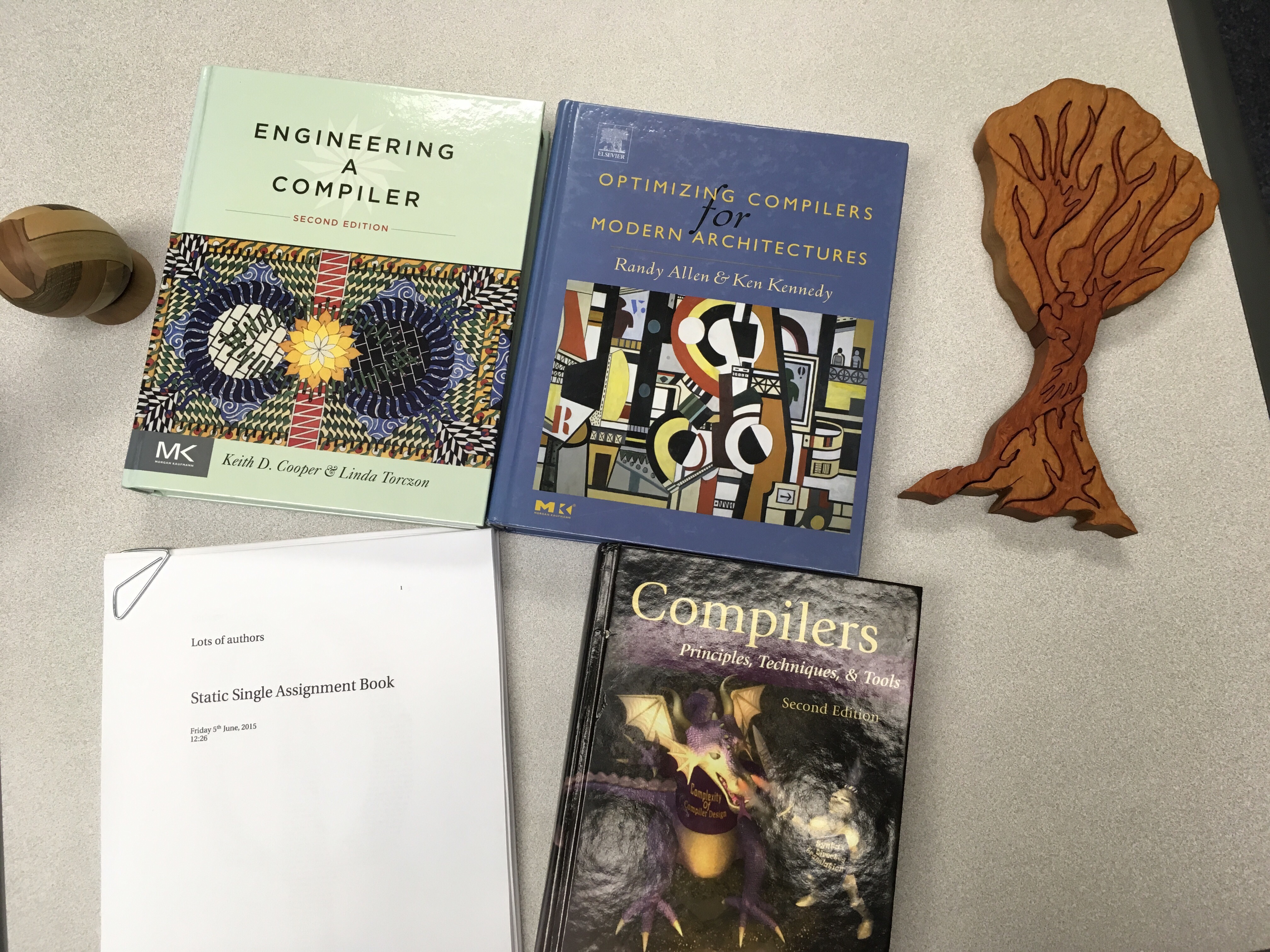
Optimizing Compilers for Modern Architectures (UR access through books24x7), Randy Allen and Ken Kennedy, Morgan Kaufmann Publishers, 2001. Chapters 1, 2, 3, 7, 8, 9, 10, 11. lecture notes from Ken Kennedy. On-line Errata
Engineering a Compiler, (2nd edition preferred, 1st okay), Keith D. Cooper and Linda Torczon, Morgan Kaufmann Publishers. Chapters 1, 8, 9, 10, 12 and 13 (both editions). lecture notes and additional reading from Keith Cooper. On-line Errata
Compilers: Principles, Techniques, and Tools (2nd edition), Alfred V. Aho, Monica S. Lam, Ravi Sethi, and Jeffrey D. Ullman, Pearson.
Static Single Assignment Book, Rastello et al. (in progress)
Tree type definitions in Haskell as answers to a homework question of CSC 253/453. They make a good demonstration how a type system can be used by a programmer to communicate its program design to the compiler, so the compiler can check correctness of the implementation automatically.
It is also a good exercise to try writing the HasMap instance for these definitions. Can you find which one of them has a “growth” problem and cannot be used in practice?