This is a course required for the Bachelor of Science degree in Computer Science at the University of Rochester. A graduate must understand in depth the underlying physical reality which the virtual world including AI is built and depends on, i.e. the fundamentals of modern computer organization, including software and hardware interfaces, assembly language and C programming, memory hierarchy and program optimization, parallelism and operating systems. The textbooks are listed here.
There are two aspects for such a course in an elite research department like mine. First, the teaching focuses on fundamentals and goes in depth, which sets a high standard but this requirement is necessary for students to learn advanced subject courses later. Second, the material is updated often and part of it even experimental. In prior semesters, my colleagues Prof. John Criswell has emphasized on assembly and operating systems, Prof. Yuhao Zhu on gates and circuits, and Prof. Sree Pai on automatic (bit operation) correctness checking. My main change is the ISA.
RISC-V Instead of x86
Instruction Set Architecture (ISA) is essential in a BS CS degree and must be learned in this course which may be most hated material by a good number of students especially who have no prior knowledge of computer hardware. In my ancient PKU years, I learned Zilog Z80 (a microcontroller) and taught MIPS (classic RISC) and x86 (Intel/AMD) last time in this course in 2012. For the 2024 course, I evaluated Arm (Apple silicons) and the newest RISC-V. RISC-V is “open-source hardware” which means free for anyone to use. The course has the room to teach just one ISA; otherwise students will rebel.
I had a year to prepare for the course and tested this idea first before deciding on this significant change — This year’s students were the first (in Rochester) to learn RISC-V.
- My NSF project with RIT has synthesized a RISC-V processor (papers here and here). I consulted my RIT collaborators who told me “x86 is too complex”, Arm is better but has “a lot of corner cases”, and for RISC-V, “I like it enough.” I learned about RISC-V over the years from computer architects to know the ISA is a good design, e.g., the first time in ASPLOS PC in 2019, but the RIT feedback made me think that the ISA is practical and learnable. The next question is whether it is teachable in a required undergrad class.
- I purchased five or six single-board computers in both Arm and RISC-V and have them installed. Department staff Ian Ward installed Linux on Lichee-Pi 4A which has a quad-core processor, a GPU, and 8GB RAM for $130. The Arm processor (Raspberry Pi 4A) is weaker and does not run Linux.
- My graduate TA Yifan Zhu (SchrodingerZhu on GitHub) installed the complete tool chain to compile and run RISC-V programs (in QEMU) on undergrad server (Intel) machines.
- I found the 2024 textbook on RISC-V as recommended by the RISC-V foundation. The book reads well and covers the core knowledge: data representation, binary file and assembly, registers, data movement and control flow, application binary interface (ABI), all in 100 pages.
Here is the result. I summerized four changes in the following question (I created) in the Course Evaluation. Here are the question and the 15 responses:
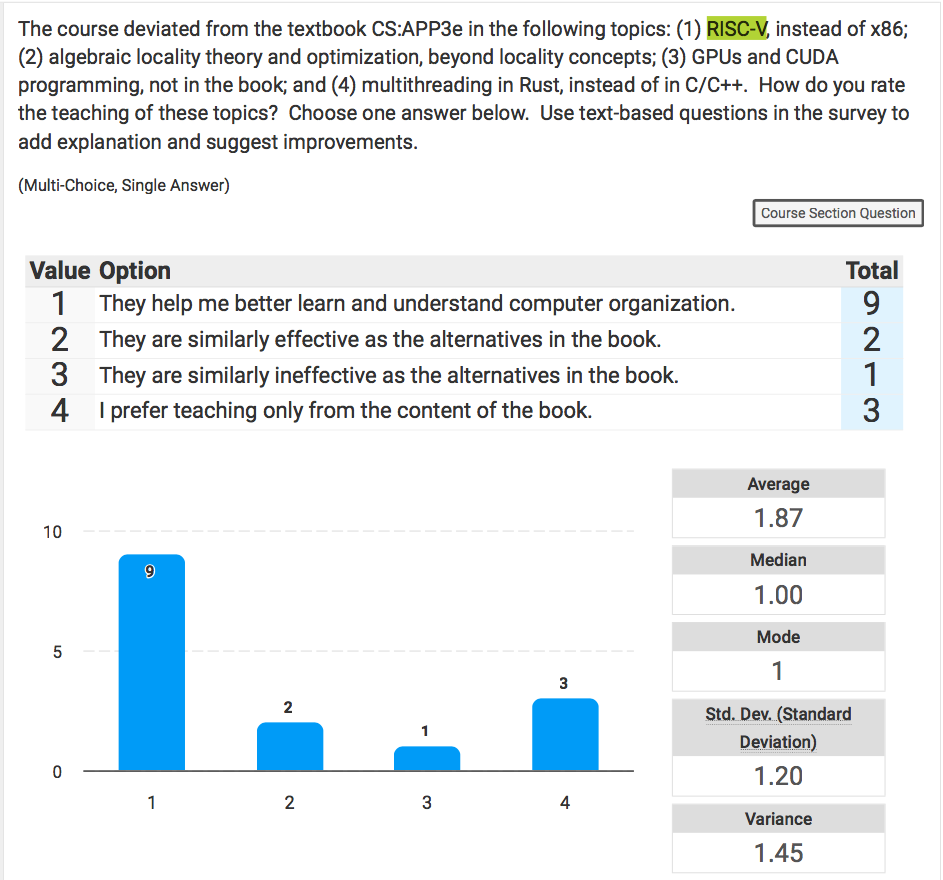
RISC-V is newer and better designed, first with a core and then a series of extensions. The book covers RV32I, the core ISA. It is challenging to learn but learnable, unlike x86 which is too unwieldy, but it is 100 pages of material. Many students read the book and learned. They crossed a threshold of knowing the complete core, which they cannot do from learning x86.
Reading Books instead of Studying for Exams
At last semester’s CS Undergrad Town Hall where most CS faculty sat to listen to students’ feedback. One is that the department changes instructors of a course, and the exams are completely different from past years. I responded that a course teaches a subject, not a subject taught in a particular way and definitely not just exams. Exams are not the goal of learning or teaching, they are the feedback for both students and their teacher.
For this course, Prof. Zhu has made available past exams, problem sets, and their solutions (which I linked to in my course page). One can learn by studying these but shouldn’t use them as the primary source. Instead, students should learn by reading the textbooks. An important use of my lectures is to motivate students to read, show organization so they have mental map going in, and explain tricky/difficult examples and parts. When I find students don’t read textbooks, I use the lecture to read the book with them. My goal is for students to read the book and read it multiple times. The RISC-V book has the full content, updated, and readily accessible online.
The next and last 25 pages of the RISC-V book covers system-level programming (not covered in the course) but reading them (if/when they need to) would be a breeze once a student reads the first 100 pages.
In-person instead of Off-line Grading
The class has 64 students. 89 students registered, 21 dropped, and 5 withdrawn. Multiple students told me that they liked the course but felt not sufficiently prepared and will take the course next semester.
I myself cannot give every student the time and attention they deserve. There is no self deception/illusion/delusion here. I hired seven undergrad TAs. To maintain consistency, they must be primarily responsible for grading. The last thing I should do is to cherry pick and over rule their work.
There are two challenges to project grading. Computer organization is standard material, and the solutions of pass assignments and projects are abundant on the Web. One may say that students who choose to copy solutions waste their time and learning opportunity so who cares, but these are young minds that are often immature, so I do care to at least make it hard for them to fall. Using RISC-V reduces the severity of the problem.
The new problem is ChatGPT and other AI tools which could program in RISC-V. My TAs solved the problem with in-person grading. Students are divided into four groups and come to a TA session each week. They were required to explain their solution. In home work, students wrote and ran RISC-V programs using an emulator. At grading time, TAs set up an actual RISC-V machine so students saw their programs running native and for real.
In one project, the binary bomb, Yifan created the setup that students had practice bombs but when they came to grading, they were given a new bomb to defuse in 15 minutes.
The Result
The end test of a course is how well students have learned after a full semester. There were a total of 869 points across all assignments and exams. The final score is the ratio of student’s points over this total number. Here is the distribution:
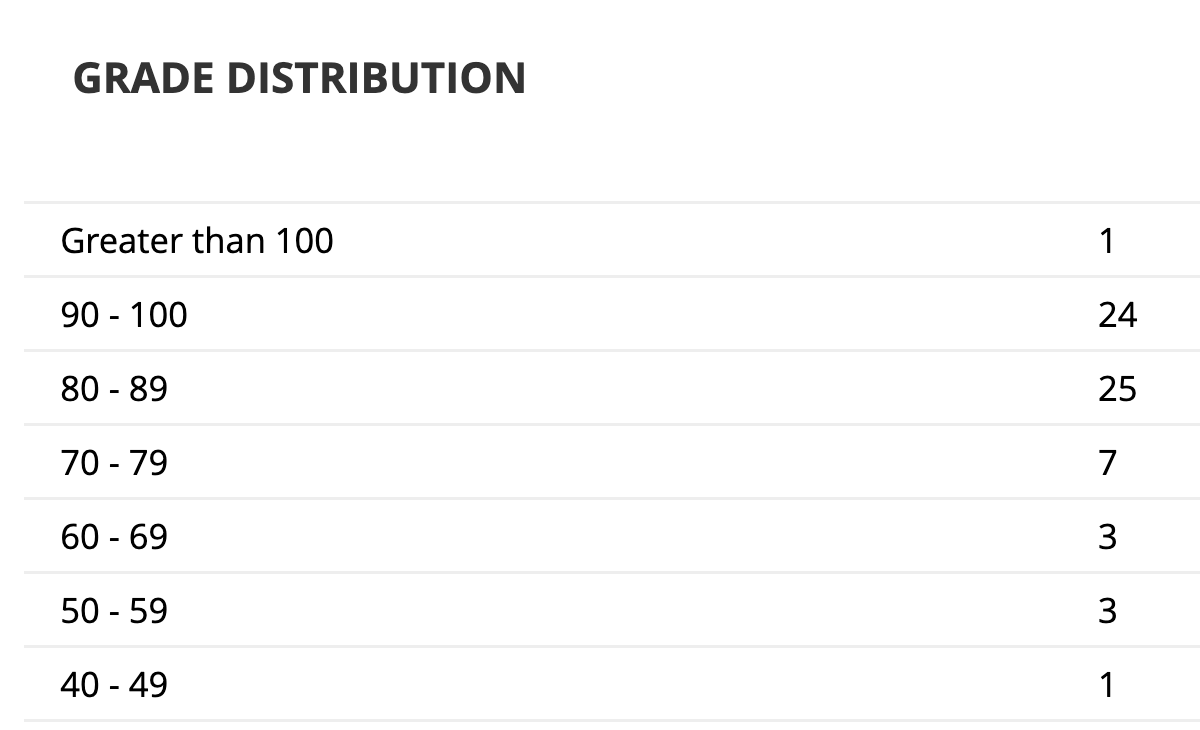
50 students scored 80% and above, and all but 7 students were 70% or higher. I had the most fun problem which was deciding between a B+ and an A- for the 8 students who were between 88.94% and 90.2%. This is much better than what I expected from such a difficult course. I remember telling my colleagues who were duly impressed by my students. I am still immensely proud of what they have done.
Parting Thoughts
“One might as well say he has sold when no one has bought as to say he has taught when no one has learned.”
— John Dewey in Logic The Theory of Inquiry
The course has its problems that can and should be improved. One that’s difficult to fix is that students learned RISC-V and then read the CS:APP textbook which uses x86. Right now, they have to map the book examples to RISC-V themselves. The evaluation score is 3.53 for overall instructor and 3.4 for the course, lower than my typical scores (here and here). Seven respondents gave the highest rating, and two the lowest. I appreciate students wrote in the evaluation and in public (here). What’s online is anecdotally true but not complete or comprehensive. My blog is partly to tell the part of the extensive learning that computer science students have accomplished in one of their courses in their four-year journey at Rochester.
Acknowledgements: including but not limited to CS staff Ian Ward and Dave Costello; my TAs Yifan, Boyang, Leo, Jacob, Kestor, Yekai, Zack, and Zachary; and my colleague John Criswell (for suggesting the xargs project).
 Rochester Programming Systems Reseach